Even in industry, microbes are used to synthesise a number of products valuable to human beings. Beverages and antibiotics are some examples. Production on an industrial scale, requires growing microbes in very large vessels called fermentors (Figure 10.4).

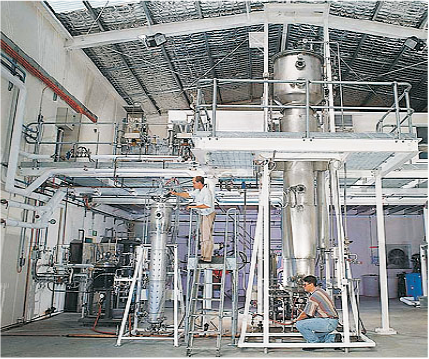
Microbes especially yeasts have been used from time immemorial for the production of beverages like wine, beer, whisky, brandy or rum. For this purpose the same yeast Saccharomyces cerevisiae used for bread-making and commonly called brewer’s yeast, is used for fermenting malted cereals and fruit juices, to produce ethanol. Do you recollect the metabolic reactions, which result in the production of ethanol by yeast? Depending on the type of the raw material used for fermentation and the type of processing (with or without distillation) different types of alcoholic drinks are obtained. Wine and beer are produced without distillation whereas whisky, brandy and rum are produced by distillation of the fermented broth. The photograph of a fermentation plant is shown in Figure 10.5.
Antibiotics produced by microbes are regarded as one of the most significant discoveries of the twentieth century and have greatly contributed towards the welfare of the human society. Anti is a Greek word that means ‘against’, and bio means ‘life’, together they mean ‘against life’ (in the context of disease causing organisms); whereas with reference to human beings, they are ‘pro life’ and not against. Antibiotics are chemical substances, which are produced by some microbes and can kill or retard the growth of other (disease-causing) microbes.
You are familiar with the commonly used antibiotic Penicillin. Do you know that Penicillin was the first antibiotic to be discovered, and it was a chance discovery? Alexander Fleming while working on Staphylococci bacteria, once observed a mould growing in one of his unwashed culture plates around which Staphylococci could not grow. He found out that it was due to a chemical produced by the mould and he named it Penicillin after the mould Penicillium notatum. However, its full potential as an effective antibiotic was established much later by Ernest Chain and Howard Florey. This antibiotic was extensively used to treat American soldiers wounded in World War II. Fleming, Chain and Florey were awarded the Nobel Prize in 1945, for this discovery.
After Penicillin, other antibiotics were also purified from other microbes. Can you name some other antibiotics and find out their sources? Antibiotics have greatly improved our capacity to treat deadly diseases such as plague, whooping cough (kali khansi), diphtheria (gal ghotu) and leprosy (kusht rog), which used to kill millions all over the globe. Today, we cannot imagine a world without antibiotics.

© 2026 GoodEd Technologies Pvt. Ltd.