
 Q. No.
In the following displacement \((x)\) versus time \((t)\) graph, at which points \(P, Q\) and \(R\) will the object's speed be increasing?

1. \(R\) only
2. \(P\) only
3. \(Q\) and \(R\) only
4. \(P,Q,R\)
2. \(P\) only
3. \(Q\) and \(R\) only
4. \(P,Q,R\)


| 1. | \(t_1<t_2 \) or \(t_1>t_2 \) depending upon whether the lift is going up or down. |
| 2. | \(t_1<t_2 \) |
| 3. | \(t_1>t_2 \) |
| 4. | \(t_1=t_2 \) |
A particle moves along a path \(ABCD\) as shown in the figure. The magnitude of the displacement of the particle from \(A\) to \(D\) is:
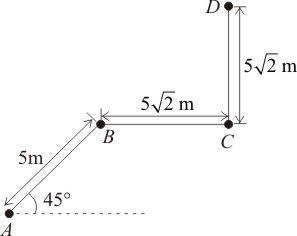
1. m
2. \(10\) m
3. m
4. \(15\) m


For the following acceleration versus time graph, the corresponding velocity versus displacement graph is:

| 1. |  |
2. |  |
| 3. |  |
4. |  |
A stone falls freely from rest from a height \(h\) and it travels a distance of \(\frac{9 h}{25}\) in the last second. The value of \(h\) is:
| 1. | \(145\) m | 2. | \(100\) m |
| 3. | \(122.5\) m | 4. | \(200\) ms |
The initial velocity of a particle is \(u\) (at \(t=0\)) and the acceleration \(f\) is given by \(at\). Which of the following relation is valid?
1. \(v = u + a t^{2}\)
2. \(v = u + a \frac{t^{2}}{2}\)
3. \(v = u + a t\)
4. \(v= u\)


Which of the following four statements is false?
| 1. | A body can have zero velocity and still be accelerated. |
| 2. | A body can have a constant velocity and still have a varying speed. |
| 3. | A body can have a constant speed and still have a varying velocity. |
| 4. | The direction of the velocity of a body can change when its acceleration is constant. |
Two cars \(A\) and \(B\) are travelling in the same direction with velocities \(v_1\) and \(v_2\) \((v_1>v_2).\) When the car \(A\) is at a distance \(d\) behind the car \(B,\) the driver of the car \(A\) applied the brake producing uniform retardation \(a.\) There will be no collision when:
1. \(d < \frac{\left( v_{1} - v_{2} \right)^{2}}{2 a}\)
2. \(d < \frac{v_{1}^{2} - v_{2}^{2}}{2 a}\)
3. \(d > \frac{\left(v_{1} - v_{2}\right)^{2}}{2 a}\)
4. \(d > \frac{v_{1}^{2} - v_{2}^{2}}{2 a}\)
| Assertion (A): | Displacement of a body may be zero when distance travelled by it is not zero. |
| Reason (R): | The displacement is the longest distance between initial and final position. |
| 1. | Both (A) and (R) are True and (R) is the correct explanation of (A). |
| 2. | Both (A) and (R) are True but (R) is not the correct explanation of (A). |
| 3. | (A) is True but (R) is False. |
| 4. | Both (A) and (R) are False. |


A particle moves a distance \(x\) in time \(t\) according to equation \(x = (t+5)^{-1}\). The acceleration of the particle is proportional to:
| 1. | \((\text{velocity})^{\frac{3}{2}}\) | 2. | \((\text{distance})^2\) |
| 3. | \((\text{distance})^{-2}\) | 4. | \((\text{velocity})^{\frac{2}{3}}\) |

© 2026 GoodEd Technologies Pvt. Ltd.