
 Q. No.
If a gas changes volume from \(2\) litres to \(10\) litres at a constant temperature of \(300~\text{K}\), then the change in its internal energy will be:
1.
\(12~\text{J}\)
2.
\(24~\text{J}\)
3.
\(36~\text{J}\)
4.
\(0~\text{J}\)


To unlock all the explanations of this course, you need to be enrolled.
To unlock all the explanations of this course, you need to be enrolled.

| 1. | \(\Delta {U}=-{W}\) in an isothermal process. |
| 2. | \(\Delta {U}={W}\) in an isothermal process. |
| 3. | \(\Delta {U}=-{W}\) in an adiabatic process. |
| 4. | \(\Delta {U}={W}\) in an adiabatic process. |
To unlock all the explanations of this course, you need to be enrolled.
To unlock all the explanations of this course, you need to be enrolled.
An ideal gas heat engine operates in a Carnot cycle between 227ºC and 127ºC. It absorbs 6 × 10⁴ cals of heat at higher temperatures.
The amount of heat converted to work will be?
1. 4.8 × 10⁴ cals
2. 2.4 × 10⁴ cals
3. 1.2 × 10⁴ cals
4. 6 × 10⁴ cals
To unlock all the explanations of this course, you need to be enrolled.
To unlock all the explanations of this course, you need to be enrolled.


Which one of the following processes is reversible?
| 1. | Transfer of heat by radiation |
| 2. | Transfer of heat by conduction |
| 3. | Isothermal compression |
| 4. | Electrical heating of a nichrome wire |
To unlock all the explanations of this course, you need to be enrolled.
To unlock all the explanations of this course, you need to be enrolled.
At a pressure of \(2\) atmospheres, a mass of diatomic gas \((\gamma = 1.4)\), is compressed adiabatically, causing its temperature to rise from \(27^{\circ}\mathrm{C}\) to \(927^{\circ}\mathrm{C}\). The pressure of the gas in the final state is:
1. 8 atm
2. 28 atm
3. 68.7 atm
4. 256 atm
To unlock all the explanations of this course, you need to be enrolled.
To unlock all the explanations of this course, you need to be enrolled.
Consider a cycle followed by an engine (figure).

1 to 2 is isothermal,
2 to 3 is adiabatic,
3 to 1 is adiabatic.
Such a process does not exist, because:
| (a) | heat is completely converted to mechanical energy in such a process, which is not possible. |
| (b) | In this process, mechanical energy is completely converted to heat, which is not possible. |
| (c) | curves representing two adiabatic processes don’t intersect. |
| (d) | curves representing an adiabatic process and an isothermal process don't intersect. |
Choose the correct alternatives:
| 1. | (a), (b) | 2. | (a), (c) |
| 3. | (b), (c) | 4. | (c), (d) |
To unlock all the explanations of this course, you need to be enrolled.
To unlock all the explanations of this course, you need to be enrolled.


The figure shows the \((P\text-V)\) diagram of an ideal gas undergoing a change of state from \(A\) to \(B.\) Four different paths \(\mathrm{I, II, III}\) and \(\mathrm{IV},\) as shown in the figure, may lead to the same change of state.

| (a) | The change in internal energy is the same in cases \(\mathrm{IV}\) and \(\mathrm{III}\) but not in cases \(\mathrm{I}\) and \(\mathrm{II}.\) |
| (b) | The change in internal energy is the same in all four cases. |
| (c) | The work done is maximum in case \(\mathrm{I}.\) |
| (d) | The work done is minimum in case \(\mathrm{II}.\) |
Which of the following options contains only correct statements?
| 1. | (b), (c) and (d) only | 2. | (a) and (d) only |
| 3. | (b) and (c) only | 4. | (a), (c) and (d) only |
To unlock all the explanations of this course, you need to be enrolled.
To unlock all the explanations of this course, you need to be enrolled.
The pressure and volume of a gas are changed as shown in the P-V diagram. The temperature of the gas will:

| 1. | increase as it goes from A to B. |
| 2. | increase as it goes from B to C. |
| 3. | remain constant during these changes. |
| 4. | decrease as it goes from D to A. |
To unlock all the explanations of this course, you need to be enrolled.
To unlock all the explanations of this course, you need to be enrolled.
Two cylinders contain the same amount of an ideal monoatomic gas. The same amount of heat is given to two cylinders. If the temperature rise in cylinder A is T0, then the temperature rise in cylinder B will be:
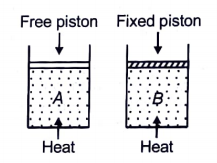
1.
2.
3.
4.
To unlock all the explanations of this course, you need to be enrolled.
To unlock all the explanations of this course, you need to be enrolled.


(where symbols have their usual meanings)
1. \(C_P = \frac{\gamma R}{\gamma-1 }\)
2. \(C_P-C_V= R\)
3. \(\Delta U = \frac{P_fV_f-P_iV_i}{1-\gamma}\)
4. \(C_V = \frac{R}{\gamma-1 }\)
To unlock all the explanations of this course, you need to be enrolled.
To unlock all the explanations of this course, you need to be enrolled.

© 2026 GoodEd Technologies Pvt. Ltd.