
 Q. No.
In an average composition of a cell, the maximum % of total cellular mass [after water and protein] is constituted by:
1. Carbohydrates
2. Lipid
3. Nucleic acids
4. Ions


Identify the option, where all the columns are not matched correctly:
| 1. | Abrin | Secondary metabolite | Drug |
| 2. | GLUT-4 | Protein | Transport carrier |
| 3. | Lecithin | Phospholipid | Cell membrane |
| 4. | Thymidylic Acid | Nucleotide | DNA |
The unique properties of each amino acid are determined by its particular:
1. R group
2. Amino group
3. Kinds of peptide bonds
4. Number of bonds to other amino acids


Given below is the graph showing the effect of substrate concentration on enzyme activity. In the presence of a competitive inhibitor, when the concentration of the substrate is progressively increased:

| 1. | The Km value increases but the reaction will not achieve Vmax |
| 2. | The Km value increases but the reaction can ultimately achieve Vmax |
| 3. | The Km value decreases but the reaction will not achieve Vmax |
| 4. | The Km value decreases but the reaction can ultimately achieve Vmax |
The compound shown below:
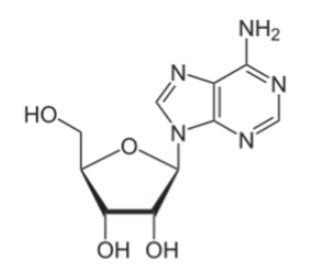
1. is a component of the ATP molecule
2. is most commonly found in ori region of DNA
3. can have enzymatic activity
4. may be a component of the cell membrane


Match each item in Column I with one item in Column II and chose your answer from the codes given below:
|
Column I (Type of secondary metabolite) |
Column II (example) |
|
I. Alkaloid II. Toxin III. Lectin IV. Drug |
1. Abrin 2. Morphine 3. Vinblastin 4. Concanavalin A |
Codes
I II III IV
1. 1 2 3 4
2. 2 1 4 3
3. 2 1 3 4
4. 1 2 4 3
Match each item in Column I with one item in Column II and chose your answer from the codes given below:
| Column I (Amino Acid) |
Column II (Nature) |
||
| I. | Tryptophan | 1. | Sulfur-containing |
| II. | Cysteine | 2. | Aromatic |
| III. | Valine | 3. | Basic |
| IV. | Lysine | 4. | Neutral |
| Options: | I | II | III | IV |
| 1. | 1 | 2 | 3 | 4 |
| 2. | 2 | 1 | 4 | 3 |
| 3. | 2 | 1 | 3 | 4 |
| 4. | 1 | 2 | 4 | 3 |
Given below is the diagrammatic representation of one of the categories of small
molecular weight organic compounds in the living tissues. Identify the category shown
and the one blank component X in it

Category Component
1. Cholesterol Guanin
2. Amino acid NH2
3. Nucleotide Adenine
4. Nucleoside Uracil


Which one of the following pairs of nitrogenous bases of nucleic acids, is wrongly matched
with the category mentioned against it?
1. Thymine, Uracil - Pyrimidines
2. Uracil, Cytosine - Pyrimidines
3. Guanine, Adenine - Purines
4. Adenine, Thymine - Purines

© 2026 GoodEd Technologies Pvt. Ltd.