
 Q. No.
Match each item in Column I with one item in Column II and chose your answer from the codes given below:
Column I
(Amino Acid)
Column II
(Nature)
I.
Tryptophan
1.
Sulfur-containing
II.
Cysteine
2.
Aromatic
III.
Valine
3.
Basic
IV.
Lysine
4.
Neutral
Options:
I
II
III
IV
1.
1
2
3
4
2.
2
1
4
3
3.
2
1
3
4
4.
1
2
4
3
(Amino Acid)
(Nature)


Given below is the diagrammatic representation of one of the categories of small
molecular weight organic compounds in the living tissues. Identify the category shown
and the one blank component X in it

Category Component
1. Cholesterol Guanin
2. Amino acid NH2
3. Nucleotide Adenine
4. Nucleoside Uracil
Which one of the following pairs of nitrogenous bases of nucleic acids, is wrongly matched
with the category mentioned against it?
1. Thymine, Uracil - Pyrimidines
2. Uracil, Cytosine - Pyrimidines
3. Guanine, Adenine - Purines
4. Adenine, Thymine - Purines


The inhibition of succinic dehydrogenase by malonate is an example of
1. competitive inhibition
2. non-competitive inhibition
3. allosteric modulation
4. none of the above
In a 50 gm living tissue, what would be the amount of water?
1. 15-25 gm
2. 25-30 gm
3. 35-45 gm
4. 70-90 gm
Which of the following elements is present in very less quantity in the body?
1. K
2. Ca
3. Mg
4. Cu


In a normal adult, ascending order of concentration of following molecules is
1. Na>K>Fe>Cu
2. Na>K>Cu>Fe
3. Fe>Na>K>Cu
4. Na>Fe>K>Cu
Match each item in Column I with one item in Column II and chose your answer from the codes given below:
|
Column I (Type of secondary metabolite) |
Column II (example) |
|
I. Alkaloid II. Toxin III. Lectin IV. Drug |
1. Abrin 2. Morphine 3. Vinblastin 4. Concanavalin A |
Codes
I II III IV
1. 1 2 3 4
2. 2 1 4 3
3. 2 1 3 4
4. 1 2 4 3


The compound shown below:
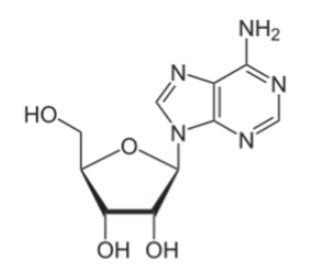
1. is a component of the ATP molecule
2. is most commonly found in ori region of DNA
3. can have enzymatic activity
4. may be a component of the cell membrane

© 2026 GoodEd Technologies Pvt. Ltd.