
 Q. No.
The moment of inertia of a uniform circular disc of radius '\(R\)' and mass '\(M\)' about an axis touching the disc at its diameter
and normal to the disc will be:
1. \(\frac{3}{2} M R^{2}\)
2. \(\frac{1}{2} M R^{2}\)
3. \(M R^{2}\)
4. \(\frac{2}{5} M R^{2}\)
1. \(\frac{3}{2} M R^{2}\)
2. \(\frac{1}{2} M R^{2}\)
3. \(M R^{2}\)
4. \(\frac{2}{5} M R^{2}\)


| 1. | \(9.9~\text m\) | 2. | \(10.1~\text m\) |
| 3. | \(10~\text m\) | 4. | \(20~\text m\) |
Three-point masses each of mass \(m,\) are placed at the vertices of an equilateral triangle of side \(a.\) The moment of inertia of the system through a mass \(m\) at \(O\) and lying in the plane of \(COD\) and perpendicular to \(OA\) is:

| 1. | \(2ma^2\) | 2. | \({2 \over 3}ma^2\) |
| 3. | \({5 \over 4}ma^2\) | 4. | \({7 \over 4}ma^2\) |


If a body is moving in a circular path with decreasing speed, then: (symbols have their usual meanings):
1. \(\overset{\rightarrow}{r} . \overset{\rightarrow}{\omega}=0\)
2. \(\overset{\rightarrow}{\tau} . \overset{\rightarrow}{v}=0\)
3. \(\overset{\rightarrow}{a} . \overset{\rightarrow}{v}<0\)
4. All of these
A solid sphere of mass \(M\) and the radius \(R\) is in pure rolling with angular speed \(\omega\) on a horizontal plane as shown in the figure. The magnitude of the angular momentum of the sphere about the origin \(O\) is:

1. \(\frac{7}{5} M R^{2} \omega\)
2. \(\frac{3}{2} M R^{2} \omega\)
3. \(\frac{1}{2} M R^{2} \omega\)
4. \(\frac{2}{3} M R^{2} \omega\)
A boy is standing on a disc rotating about the vertical axis passing through its centre. He pulls his arms towards himself, reducing his moment of inertia by a factor of m. The new angular speed of the disc becomes double its initial value. If the moment of inertia of the boy is I0 , then the moment of inertia of the disc will be:
1.
2.
3.
4.


Four masses are joined to light circular frames as shown in the figure. The radius of gyration of this system about an axis passing through the center of the circular frame and perpendicular to its plane would be:
(where '\(a\)' is the radius of the circle)

1. \(\frac{a}{\sqrt{2}}\)
2. \(\frac{a}{{2}}\)
3. \(a\)
4. \(2a\)

1. \(\frac{5}{3}mL^2\)
2. \(4mL^2\)
3. \(\frac{1}{4}mL^2\)
4. \(\frac{2}{3}mL^2\)
1. \(\vec{\tau}=(-17 \hat{\mathrm{i}}+6 \hat{\mathrm{j}}+4 \widehat{\mathrm{k}})\) N-m
2. \(\vec{\tau}=(-17 \hat{\mathrm{i}}+6 \hat{\mathrm{j}}-4 \widehat{\mathrm{k}}) \) N-m
3. \(\vec{\tau}=(17 \hat{\mathrm{i}}-6 \hat{\mathrm{j}}+4 \widehat{\mathrm{k}})\) N-m
4. \(\vec{\tau}=(-41 \hat{\mathrm{i}}+6 \hat{\mathrm{j}}+16 \hat{\mathrm{k}})\) N-m


In the three figures, each wire has a mass M, radius R and a uniform mass distribution. If they form part of a circle of radius R, then about an axis perpendicular to the plane and passing through the centre (shown by crosses), their moment of inertia is in the order:
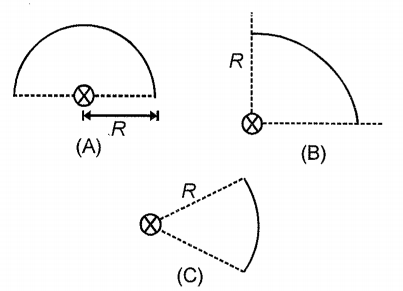
1.
2.
3.
4.

© 2026 GoodEd Technologies Pvt. Ltd.