Select Chapter Topics:

 Q. No.
A negative point charge \((-q)\) is placed at the centre of a spherical ball of charge distributed uniformly over its volume. The radius of the ball is \(R.\) The electric field on its surface is zero. The potential on its surface is:
1.
zero
2.
\(\dfrac{kq }{2R}\)
3.
\(\dfrac{-kq }{ 2R}\)
4.
\(\dfrac{2kq }{ R}\)


Subtopic: Electric Potential |
64%
Level 2: 60%+
Hints

Four charges \(q,q\) and \(-q,-q\) are placed at the four vertices of a square of side \(a,\) with like charges across the diagonal. The potential at the center of the square is:
| 1. | zero | 2. | \(\sqrt2\dfrac{kq}{a}\) |
| 3. | \(2\dfrac{kq}{a}\) | 4. | \(4\dfrac{kq}{a}\) |
Subtopic: Electric Potential |
85%
Level 1: 80%+
Hints
The angle between the electric lines of force and the equipotential surface is:
| 1. | \(180^\circ\) | 2. | \(0^\circ\) |
| 3. | \(45^\circ\) | 4. | \(90^\circ\) |
Subtopic: Equipotential Surfaces |
83%
Level 1: 80%+
NEET - 2022
Hints


Four particles having identical charges are placed at the four corners of a square of side \(2~\text m.\) The potential at the centre of the square is \(2\sqrt2~\text V. \) The potential energy of the system of charges is \(U_0.\) If the charges are brought closer so that each side of the square is \(1~\text m,\) then the new potential energy of the system will be:
1. \(U_0\)
2. \(\dfrac{U_0}{2}\)
3. \(2U_0\)
4. \(4U_0\)
1. \(U_0\)
2. \(\dfrac{U_0}{2}\)
3. \(2U_0\)
4. \(4U_0\)
Subtopic: Electric Potential Energy |
66%
Level 2: 60%+
Hints
The capacitance of a system of concentric conducting spherical shells is \(2~\mu\text F.\) If the radii of both the shells are doubled, then the capacitance of the system will be:
| 1. | \(8~\mu\text F\) | 2. | \(4~\mu\text F\) |
| 3. | \(1~\mu\text F\) | 4. | \(0.5~\mu\text F\) |
Subtopic: Capacitance |
65%
Level 2: 60%+
Hints

Unlock IMPORTANT QUESTION
This question was bookmarked by 5 NEET 2025 toppers during their NEETprep journey. Get Target Batch to see this question.
✨ Perfect for quick revision & accuracy boost
Buy Target Batch
Access all premium questions instantly
A charge is uniformly distributed on the circumference of a disc, and the potential at its centre is \(5\) volt. If the charge was uniformly distributed on the surface of this disc, the potential at a point \(P\) on its axis, at a distance equal to the disc's radius from its centre, equals:
1. \(10\) V
2. \(5 \sqrt 2\) V
3. \(10 \sqrt 2\) V
4. \(10 (\sqrt {2} -1)\) V
1. \(10\) V
2. \(5 \sqrt 2\) V
3. \(10 \sqrt 2\) V
4. \(10 (\sqrt {2} -1)\) V
Subtopic: Electric Potential |
Level 3: 35%-60%
Hints


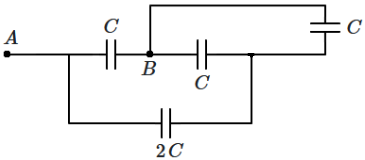
The equivalent capacitance of the circuit between the points \(A~\text{and}~B\) is equal to:
1. \(2C\)
2. \(\dfrac{3C}{2}\)
3. \(3C\)
4. \(\dfrac{5C}{2}\)
1. \(2C\)
2. \(\dfrac{3C}{2}\)
3. \(3C\)
4. \(\dfrac{5C}{2}\)
Subtopic: Combination of Capacitors |
66%
Level 2: 60%+
Hints
The left plate \(A\) of an air capacitor is connected to the positive terminal while the right plate \(B\) is connected to the negative terminal of a cell of voltage \(V_0.\) Assume that the plate area is \(A,\) and the plate separation is \(d.\) If a slab of dielectric constant \(K\) is inserted into the space between the plates, the electric field in the dielectric will be: (compared to the air capacitor)

| 1. | more. |
| 2. | less. |
| 3. | equal. |
| 4. | more or less or equal depending on the value of \(K\). |
Subtopic: Dielectrics in Capacitors |
Level 3: 35%-60%
Hints
A dipole (\(p\)) is placed so that it is always aligned along the x-axis but it can undergo displacement along the x-axis. The dipole is placed exactly midway between two fixed charges \(-Q\) and \(Q,\) in two possible ways.
 Then, the dipole is:
Then, the dipole is:
| 1. | stable in both \(A,B\) |
| 2. | stable in \(A\), unstable in \(B\) |
| 3. | unstable in \(A\), stable in \(B\) |
| 4. | unstable in both \(A,B\) |
Subtopic: Energy of Dipole in an External Field |
58%
Level 3: 35%-60%
Hints


A dielectric slab is inserted between the plates of an isolated charged capacitor. Which of the following quantities will remain the same?
| (a) | the electric field in the capacitor |
| (b) | the charge on the capacitor |
| (c) | the potential difference between the plates |
| (d) | the stored energy in the capacitor |
Choose the correct option:
1. (a), (b)
2. (b) only
3. (c), (a)
4. (a), (d)
Subtopic: Dielectrics in Capacitors |
78%
Level 2: 60%+
Hints
Links
Select Chapter Topics:

© 2026 GoodEd Technologies Pvt. Ltd.