Select Chapter Topics:

 Q. No.
The current through an ideal \(\mathrm{p\text-n}\) junction diode shown in the circuit will be:

1.
\(5~\text A\)
2.
\(0.2~\text A\)
3.
\(0.6~\text A\)
4.
zero


Subtopic: PN junction |
67%
Level 2: 60%+
Hints

When a forward bias is applied to a \(\mathrm{p\text-n}\) junction, then what happens to the potential barrier \(V_B,\) and the width of charge depleted region \(x\)?
| 1. | \(V_B\) increases, \(x\) decreases | 2. | \(V_B\) decreases, \(x\) increases |
| 3. | \(V_B\) increases, \(x\) increases | 4. | \(V_B\) decreases, \(x\) decreases |
Subtopic: PN junction |
71%
Level 2: 60%+
Hints
A potential barrier of \(0.50~\text V\) exists across a \(\mathrm{p\text-n}\) junction. If the depletion region is \(5.0\times10^{-7}~\text{m}\) wide, the intensity of the electric field in this region is:
| 1. | \(1.0 \times 10^6 ~\text{V/m}\) | 2. | \(1.0 \times 10^5 ~\text{V/m}\) |
| 3. | \(2.0 \times 10^5 ~\text{V/m}\) | 4. | \(2.0 \times 10^6 ~\text{V/m}\) |
Subtopic: PN junction |
84%
Level 1: 80%+
Hints


A Zener diode is shown in the following circuit diagram. When the source voltage fluctuates such that \(V>V_z\) then:
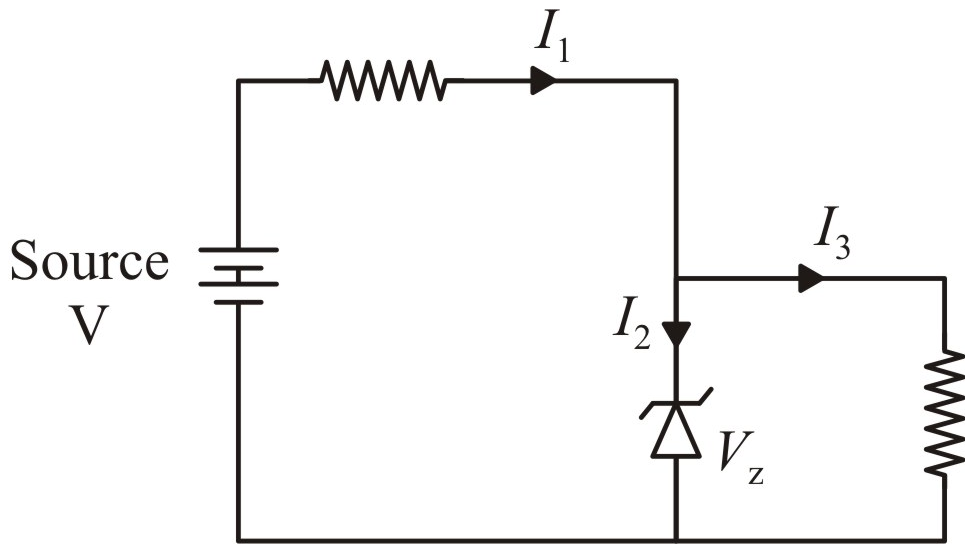
| 1. | all the current \(I_1, I_2~\text{and}~I_3\) change. |
| 2. | only \(I_1\) and \(I_2\) change and \(I_3\) remains constant. |
| 3. | only \(I_1\) and \(I_3\) change and \(I_2\) remains constant. |
| 4. | all the currents remain constant. |
Subtopic: Applications of PN junction |
71%
Level 2: 60%+
Hints
What is the reading of the ideal ammeters \(A_1\) and \(A_2\) connected in the given circuit diagram, if \(\mathrm{p\text-n}\) junction diodes are ideal?

| 1. | \(2~\text A\) and zero | 2. | \(3~\text A\) and \(2~\text A\) |
| 3. | \(2~\text A\) and \(3~\text A\) | 4. | Zero and \(2~\text A\) |
Subtopic: PN junction |
84%
Level 1: 80%+
Hints
Which of the following graphs may correctly represent the variation of current \((I)\) with potential difference \((V)\) across a zener diode?
| 1. |  |
2. |  |
| 3. |  |
4. |  |
Subtopic: Applications of PN junction |
88%
Level 1: 80%+
Hints



Subtopic: Logic gates |
74%
Level 2: 60%+
Hints
A Zener diode is used to obtain a constant voltage. If the applied voltage \(V\) changes, then:
(\( V\) is more than Zener voltage)

| 1. | \(i_{1}\) and \(i_{2}\) change. |
| 2. | \(i_{2}\) and \( V_{0}\) change and \(i_{3}\) remain constant. |
| 3. | \(i_{2}\) and \(V_{0}\) don't change while \(i_{3}\) changes. |
| 4. | \(i_{3}\) and \( V_{0}\) don't change while \(i_{2}\) changes. |
Subtopic: Applications of PN junction |
65%
Level 2: 60%+
Hints
In the given circuit, the power developed in the \(2~\text{k}\Omega\) resistor is:

1. \(36~\text{mW}\)
2. \(12~\text{mW}\)
3. \(144~\text{mW}\)
4. \(72~\text{mW}\)
Subtopic: Applications of PN junction |
75%
Level 2: 60%+
Hints


The LED:
| 1. | is reverse-biased. |
| 2. | is forward-biased. |
| 3. | can be made of \(\mathrm{GaAs}.\) |
| 4. | both (2) and (3) are correct. |
Subtopic: Applications of PN junction |
72%
Level 2: 60%+
Hints
Select Chapter Topics:

© 2026 GoodEd Technologies Pvt. Ltd.