Given below are two statements: one is labeled as Assertion (A) and the other is labeled as Reason (R):
Assertion (A):
Helium is used to dilute oxygen in the diving apparatus.
Reason (R):
Helium has a high solubility in O2.
In light of the above statements, choose the correct answer from the options given below:
1.
(A) is False but (R) is True.
2.
Both (A) and (R) are True and (R) is the correct explanation of (A).
3.
Both (A) and (R) are True and (R) is not the correct explanation of (A).
4.
(A) is True but (R) is False.


Subtopic: Concentration Terms & Henry's Law |
51%
Level 3: 35%-60%
NEET - 2023
Hints

Given below are two statements: one is labelled as Assertion (A) and the other is labelled as Reason (R):
In the light of the above statements choose the correct answer from the options given below:
| Assertion (A): | Metallic sodium dissolves in liquid ammonia giving a deep blue solution, which is paramagnetic. |
| Reason (R): | The deep blue solution is due to the formation of amide. |
| 1. | (A) is False but (R) is True. |
| 2. | Both (A) and (R) are True and (R) is the correct explanation of (A). |
| 3. | Both (A) and (R) are True and (R) is not the correct explanation of (A). |
| 4. | (A) is True but (R) is False. |
Subtopic: Reasoning Questions |
Level 3: 35%-60%
NEET - 2023
Hints
The correct order of energies of molecular orbitals of N2 molecule is:
| 1. | \( \sigma \text { 1s }<\sigma^* \text { 1s }<\sigma 2 s<\) \(\sigma^* 2 s<\left(\pi 2 p_x=\pi 2 p_y\right)<\) \(\left(\pi^* 2 p_x=\pi^* 2 p_y\right)<\sigma 2 p_z<\sigma^* 2 p_z\) |
| 2. | \( \sigma \text { 1s }<\sigma^* \text { 1s }<\sigma 2 s<\sigma^* 2 s<\) \(\left(\pi 2 p_x=\pi 2 p_y\right)< \) \(\sigma 2 p_z<\left(\pi^* 2 p_x=\pi^* 2 p_y\right)<\sigma^* 2 p_z \) |
| 3. | \( \sigma \text { 1s }<\sigma^* \text { 1s }<\sigma 2 s<\sigma^* 2 s<\sigma 2 p_z<\) \( \left(\pi 2 p_x=\pi 2 p_y\right)<\) \(\left(\pi^* 2 p_x=\pi^* 2 p_y\right)<\sigma^* 2 p_z \) |
| 4. | \( \sigma \text { 1s }<\sigma^* \text { 1s }\) \(<\sigma 2 s<\sigma^* 2 s<\sigma 2 p_z< \) \( \sigma^* 2 p_z<\left(\pi 2 p_x=\pi 2 p_y\right)<\) \(\left(\pi^* 2 p_x=\pi^* 2 p_y\right) \) |
Subtopic: M.O.T |
73%
Level 2: 60%+
NEET - 2023
Hints


Given below are two statements:
| Assertion (A): | A reaction can have zero activation energy. |
| Reason (R): | The minimum amount of energy required by reactant molecules so that their energy becomes equal to threshold value, is called activation energy. |
| 1. | (A) is False but (R) is True. |
| 2. | Both (A) and (R) are True and (R) is the correct explanation of (A) |
| 3. | Both (A) and (R) are True but (R) is not the correct explanation of (A). |
| 4. | (A) is True but (R) is False. |
Subtopic: Arrhenius Equation |
Level 4: Below 35%
NEET - 2023
Hints
Weight (g) of two moles of the organic compound, which is obtained by heating sodium ethanoate with sodium hydroxide in the presence of calcium oxide is:
1. 18
2. 16
3. 32
4. 30
1. 18
2. 16
3. 32
4. 30
Subtopic: Carboxylic Acids: Preparation & Properties |
64%
Level 2: 60%+
NEET - 2023
Hints
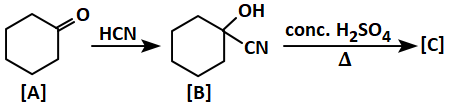


Subtopic: Aldehydes & Ketones: Preparation & Properties | Carboxylic Acids: Preparation & Properties |
64%
Level 2: 60%+
NEET - 2023
Hints


Select the correct statements from the following:
Choose the correct answer from the options given below:
| A: | Atoms of all elements are composed of two fundamental particles. |
| B: | The mass of the electron is \(9.10939 \times 10^{-31} \mathrm{~kg} \text {. }\) |
| C: | All the isotopes of a given element show the same chemical properties. |
| D: | Protons and electrons are collectively known as nucleons. |
| E: | Dalton's atomic theory regarded the atom as an ultimate particle of matter. |
| 1. | B, C and E only | 2. | A, B and C only |
| 3. | C, D and E only | 4. | A and E only |
Subtopic: Introduction |
76%
Level 2: 60%+
NEET - 2023
Hints
The stability of Cu2+ is greater than that of Cu+ salts in an aqueous solution due to:
1. Second ionisation enthalpy
2. First ionisation enthalpy
3. Enthalpy of atomization
4. Hydration energy
1. Second ionisation enthalpy
2. First ionisation enthalpy
3. Enthalpy of atomization
4. Hydration energy
Subtopic: d-Block Elements- Properties & Uses |
73%
Level 2: 60%+
NEET - 2023
Hints
The relation between \(n_m \) (\(n_m \) = number of permissible values of magnetic quantum number (ml) for a given value of azimuthal quantum number (l) is:
| 1. | \(n_m = l+2\) | 2. | \(l = {\dfrac{n_m -1} 2}\) |
| 3. | \(l= 2n_m +1\) | 4. | \(n_m = 2l^2 + 1 \) |
Subtopic: Shell & Subshell |
69%
Level 2: 60%+
NEET - 2023
Hints


Intermolecular forces are forces of attraction and repulsion between interacting particles that will be:
Choose the most appropriate answer from the options given below:
1. A, C, D, E are correct
2. B, C, D, E are correct
3. A, B, C, D, E are correct
4. A, B, C, E are correct
| A. | dipole - dipole forces |
| B. | dipole-induced dipole forces |
| C. | hydrogen bonding |
| D. | covalent bonding |
| E. | dispersion forces |
1. A, C, D, E are correct
2. B, C, D, E are correct
3. A, B, C, D, E are correct
4. A, B, C, E are correct
Subtopic: Introduction to States of Matter |
Level 3: 35%-60%
NEET - 2023
Hints

© 2026 GoodEd Technologies Pvt. Ltd.