Botany - Section A
1. In reference to the given figure, the position of ovary and type of flowers respectively will be:

1. Superior, Hypogynous
2. Inferior, Epigynous
3. Half-inferior, Perigynous
4. Inferior, Epigynous
2. Which one of the following matches is correct?
| (a) |
Phytophthora |
Aseptate Mycelium |
Basidiomycetes |
| (b) |
Alternaria |
Sexual reproduction Absent |
Deuteromycetes |
| (c) |
Mucor |
Reproduction by conjugation |
Ascomycetes |
| (d) |
Agaricus |
Parasitic fungus |
Basidiomycetes |
1. (a)
2. (b)
3. (c)
4. (d)
3. The most abundant prokaryotes helpful to human in making curd from milk and in production of antibiotics are the ones categorized as:
| 1. |
Cyanobacteria |
2. |
Archaebacteria |
| 3. |
Chemosynthetic autotrophs |
4. |
Heterotrophic bacteria |
4. Consider the two statements:
| Assertion (A): |
Iodine-KI reagent can be used to detect starch in a sample. |
| Reason (R): |
Starch can hold iodine molecules in its helical portion and starch-iodine is blue in colour. |
| 1. |
Both (A) and (R) are True but (R) does not correctly explain(A). |
| 2. |
(A) is True but (R) is False. |
| 3. |
Both (A) and (R) are False. |
| 4. |
Both (A) and (R) are True and (R) correctly explains (A). |
5. The non-technical term Bark in an old woody stem does not include:
| 1. |
Cork |
2. |
Secondary phloem |
| 3. |
Secondary cortex |
4. |
Vascular cambium |
6. All the following regarding collenchyma tissue in plants are correct except:
| 1. |
It occurs below the epidermis of stem and leaves in most monocots |
| 2. |
It is found either as a homogenous layer or in patches |
| 3. |
Cells are much thickened at the corners |
| 4. |
Intercellular spaces are absent |
7. Pericarp is a derivative of:
| 1. |
integuments |
2. |
ovule wall |
| 3. |
ovary wall |
4. |
placenta |
8. Match each item in COLUMN I with one in COLUMN II and select the correct match from the codes given:
|
COLUMN I
[Modification of plant part] |
|
COLUMN II
[Example] |
| A |
Leaf spine |
P |
Pea |
| B |
Leaf tendril |
Q |
Bougainvillea |
| C |
Stem tendril |
R |
Cucumber |
| D |
Stem thorn |
S |
Cactus |
Codes:
|
A |
B |
C |
D |
| 1. |
P |
R |
Q |
S |
| 2. |
S |
R |
P |
Q |
| 3. |
S |
P |
R |
Q |
| 4. |
S |
P |
Q |
R |
9. Identify the correct set of statements:
| (a) |
The leaflets are modified into pointed hard thorns in Citrus and Bougainvillea |
| (b) |
Axillary buds form slender and spirally coiled tendrils in cucumber and pumpkin |
| (c) |
Stem is flattened and fleshy in Opuntia and modified to perform the function of leaves |
| (d) |
Rhizophora shows vertically upward growing roots that help to get oxygen for respiration |
| (e) |
Subaerially growing stems in grasses and strawberry help in vegetative propagation |
Choose the correct answer from the options given below:
1. (a), (b), (d), and (e) only
2. (b), (c) only
3. (a), (d) only
4. (b), (c), (d) and (e) only
10. In an epigynous flower, the ovary is situated:
| 1. |
below other floral parts |
| 2. |
above other floral parts |
| 3. |
at the same level as other floral parts |
| 4. |
not on the thalamus |
11. What is the correct description of a prothallus?
| 1. |
A structure in gymnosperms formed just after fertilisation |
| 2. |
A sporophytic free living structure formed in pteridophytes |
| 3. |
A gametophytic free living structure formed in pteridophytes |
| 4. |
Sex organs bearing stage in Bryophytes |
12. How many of the given statements regarding various modifications in leaves are correct?
| I. |
Leaves are modified into tendrils for climbing as in pea. |
| II. |
Leaves are modified into spines for defence as in cacti. |
| III. |
The leaves of onion and garlic store food. |
| IV. |
In Australian acacia, petioles expand, become green and synthesize food. |
| V. |
The trapping structure of venus fly trap and pitcher of pitcher plant are modified leaves. |
13. In
Cycas:
| I: |
coralloid roots are associated with N2-fixing cyanobacteria |
| II: |
the stems are unbranched |
| III: |
the pinnate leaves persist for a few years |
| 1. |
Only I and II are correct |
| 2. |
Only I and III are correct |
| 3. |
Only II and III are correct |
| 4. |
I, II and III are correct |
14. In angiosperms:
| 1. |
the outside of the root epidermis is often covered with a waxy thick layer called the cuticle. |
| 2. |
the guard cells possess chloroplasts. |
| 3. |
the root hairs are usually multi-cellular. |
| 4. |
the trichomes in the shoot system are usually unicellular. |
15. The stems of maize and sugarcane have:
| 1. |
stilt roots that are hanging and supporting structures |
| 2. |
prop roots that are hanging and supporting structures |
| 3. |
prop roots coming out from the nodes in upper stem |
| 4. |
supporting stilt roots coming out of the lower nodes of the stem |
16. Which of the following will not be true for gymnosperms?
| 1. |
Gymnosperms lack vessels in their xylem. |
| 2. |
Gymnosperms have albuminous cells and sieve cells. |
| 3. |
Gymnosperms lack sieve tubes and companion cells. |
| 4. |
Gymnosperms lack secondary growth. |
17. Root hairs develop from the region of:
| 1. |
Elongation |
2. |
Root cap |
| 3. |
Meristematic activity |
4. |
Maturation |
18. Consider the following statements:
| I: |
Imbricate aestivation is seen in Cassia and gulmohar. |
| II: |
In Dianthus and Primrose, placentation is free central. |
| III: |
Seeds of pea, gram and bean are non-endospermous. |
Which of the above statements are true?
| 1. |
I and II only |
2. |
I and III only |
| 3. |
II and III only |
4. |
I, II and III |
19. Consider the two statements:
| Assertion (A): |
In a plant cell, the concentration of a number of ions is significantly higher in the vacuole than in the cytoplasm. |
| Reason (R): |
The tonoplast facilitates the transport of a number of ions and other materials against concentration gradients into the vacuole. |
| 1. |
Both (A) and (R) are True and (R) is the correct explanation of (A). |
| 2. |
Both (A) and (R) are True but (R) is not the correct explanation of (A). |
| 3. |
(A) is True but (R) is False. |
| 4. |
Both (A) and (R) are False. |
20. Consider the following statements:
| I: |
Whorled phyllotaxy is seen in Alstonia. |
| II: |
Flowers of mustard, datura and chilli are actinomorphic. |
| III: |
The ovary in plum, peach and rose is epigynous. |
Which of the above statements are true?
| 1. |
I and II only |
2. |
I and III only |
| 3. |
II and III only |
4. |
I, II and III |
21. Infectious proteins are present in:
| 1. |
geminiviruses |
2. |
prions |
| 3. |
viroids |
4. |
satellite viruses |
22. Select the wrong statement from the following:
| 1. |
Both chloroplast and mitochondria contain an inner and an outer membrane. |
| 2. |
Both chloroplasts and mitochondria have an internal compartment, the thylakoid space bounded by the thylakoid membrane. |
| 3. |
Both chloroplasts and mitochondria contain DNA. |
| 4. |
The chloroplasts are generally much larger than mitochondria. |
23. The technical term used for the androecium in a flower of China rose (Hibiscus rosa-sinensis) is:
| 1. |
monadelphous |
2. |
diadelphous |
| 3. |
polyandrous |
4. |
polyadelphous |
24. Consider the two statements:
| Statement I: |
Bryophytes usually occur in damp, humid and shaded localities and are not truly ‘successful’ on land. |
| Statement II: |
They are dependent on water for sexual reproduction. |
| 1. |
Statement I is correct and Statement II is incorrect |
| 2. |
Both Statement I and Statement II are correct and Statement II explains Statement I |
| 3. |
Statement I is incorrect and Statement II is correct |
| 4. |
Both Statement I and Statement II are correct but Statement II does not explain Statement I |
25. Match each item in Column-I (Protist) with one in Column-II (Characteristic) and select the correct option:
|
Column-I (Protist) |
|
Column-II (Characteristic) |
| A. |
Chrysophytes |
P. |
Plasmodium |
| B. |
Dinoflagellates |
Q. |
Chief producers in the ocean |
| C. |
Euglenoids |
R. |
Stiff cellulose plates in cell wall on outer surface |
| D. |
Slime moulds |
S. |
Two flagella, one long and one short |
Codes:
|
A |
B |
C |
D |
| 1. |
R |
Q |
S |
P |
| 2. |
Q |
S |
P |
R |
| 3. |
Q |
R |
S |
P |
| 4. |
R |
S |
Q |
P |
26. Match each item in Column I with one in Column II and select the correct match from the codes given:
|
Column I |
|
Column II |
| A |
Ulothrix |
P |
Brown algae with diplontic life cycle |
| B |
Ectocarpus |
Q |
Major pigments are chlorophyll a and b |
| C |
Fucus |
R |
Brown algae with haplo-diplontic life cycle |
| D |
Polysiphonia |
S |
Lack flagella |
Codes:
|
A |
B |
C |
D |
| 1. |
P |
S |
Q |
R |
| 2. |
Q |
P |
R |
S |
| 3. |
Q |
R |
P |
S |
| 4. |
R |
Q |
S |
P |
27. Match each item in
Column-I with one in
Column-II regarding taxonomic categories of wheat and select the correct match from the codes given:
|
Column-I |
|
Column-II |
| A. |
Family |
P. |
Monocotyledonae |
| B. |
Order |
Q. |
Poaceae |
| C. |
Class |
R. |
Angiospermae |
| D. |
Division |
S. |
Poales |
Codes:
|
A |
B |
C |
D |
| 1. |
S |
Q |
R |
P |
| 2. |
S |
Q |
P |
R |
| 3. |
Q |
S |
P |
R |
| 4. |
Q |
S |
R |
P |
28. Which one is
wrongly matched?
| 1. |
Uniflagellate gametes - Polysiphonia |
| 2. |
Biflagellate zoospores - Brown algae |
| 3. |
Gemma cups - Marchantia |
| 4. |
Unicellular organism - Chlorella |
29. Consider the two statements:
| Statement I: |
Ribosomes are non-membrane bound organelles found in all cells. |
| Statement II: |
Animal cells contain a non-membrane bound organelle called centrosome which helps in cell division. |
| 1. |
Statement I is correct; Statement II is correct |
| 2. |
Statement I is correct; Statement II is incorrect |
| 3. |
Statement I is incorrect; Statement II is correct |
| 4. |
Statement I is incorrect; Statement II is incorrect |
30. Identify the incorrect statement regarding the cell cycle of a typical eukaryotic cell:
| 1. |
The interphase lasts more than 95% of the duration of the cell cycle. |
| 2. |
M phase starts with the nuclear division. |
| 3. |
Interphase is the resting stage in the cell cycle where the cell is metabolically inactive. |
| 4. |
Neurons in human body are permanently in G0 phase of the cell cycle. |
31. Crossing over takes place between which chromatids and in which stage of the cell cycle?
| 1. |
Non-sister chromatids of non-homologous chromosomes at Zygotene stage of prophase I. |
| 2. |
Non-sister chromatids of homologous chromosomes at Pachytene stage of prophase I. |
| 3. |
Non-sister chromatids of homologous chromosomes at Zygotene stage of prophase I. |
| 4. |
Non-sister chromatids of non-homologous chromosomes at Pachytene stage of prophase I. |
32. Classification system based on information like chromosome number, structure, behaviour is called as:
1. Numerical taxonomy
2. Cytotaxonomy
3. Chemotaxonomy
4. Cladistics
33. Match each item in
Column-I with one in
Column-II and select the correct match from the codes given:
|
Column-I [Protist] |
|
Column-II [Feature of wall] |
| A. |
Diatoms |
P. |
Cell wall has stiff cellulose plates on outer surface |
| B. |
Dinoflagellates |
Q. |
Cell wall embedded with silica |
| C. |
Euglenoids |
R. |
Protein rich layer instead of a cell wall |
| D. |
Slime moulds |
S. |
True walls in spores |
Codes:
|
A |
B |
C |
D |
| 1. |
Q |
P |
R |
S |
| 2. |
Q |
P |
S |
R |
| 3. |
P |
Q |
R |
S |
| 4. |
P |
Q |
S |
R |
34. Consider the two given statements:
| Statement I: |
Association between mycobiont and phycobiont is found in Lichens. |
| Statement II: |
An association between roots of higher plants and fungi is called mycorrhiza. |
1.
Statement I is correct;
Statement II is incorrect
2.
Statement I is correct;
Statement II is correct
3.
Statement I is incorrect;
Statement II is incorrect
4.
Statement I is incorrect;
Statement II is correct
35. Which of the following are most suitable indicators of SO2 pollution in the environment?
1. Lichens
2. Conifers
3. Algae
4. Fungi
Botany - Section B
36. Given are the following five statements (I - V) for your consideration:
| I: |
In Equisetum, the female gametophyte is retained on the parent sporophyte |
| II: |
In Ginkgo, the male gametophyte is not independent |
| III: |
The sporophyte in Marchantia is more developed than that in Polytrichum |
| IV: |
Sexual reproduction in Volvox is isogamous |
| V: |
The spores of slime moulds lack cell walls |
How many of the above statements is/are correct?
| 1. |
Three |
2. |
Four |
| 3. |
One |
4. |
Two |
37. Study the given diagram of phloem tissue in angiosperms and select the correct statements:

| Statement I: |
‘A’ at maturity lose its protoplasm and becomes dead. |
| Statement II: |
‘B’ stores food material and other substances like resins, latex, and mucilage. |
1.
Statement I is incorrect;
Statement II is correct
2.
Statement I is correct;
Statement II is incorrect
3.
Statement I is correct;
Statement II is correct
4.
Statement I is incorrect;
Statement II is incorrect
38. Which of the following statements would be true for brown algae?
| 1. |
Major pigments are chlorophyll a, c and fucoxanthin. |
| 2. |
Food is stored as floridean starch. |
| 3. |
Vegetative cells have wall made of cellulose, pectin and polysulphate esters. |
| 4. |
Flagellar number and insertions are 2, equal and apical. |
39. How many organisms in the list given below are autotrophs?
| Lactobacillus, Nostoc, Chara, Nitrosomonas, Nitrobacter, Streptomyces, Saccharomyces, Trypanosoma, Porphyra, Wolfia |
1. Five
2. Six
3. Three
4. Four
40. Identify the correct statement regarding the part of a cell, the structure of which is shown in the given diagram:

| 1. |
It is not found in the plant cells |
| 2. |
It serves to provide an attachment with a surface for a bacterial cell |
| 3. |
The structure is made of a protein called flagellin |
| 4. |
It can be used for movement by a eukaryotic cell |
41. At the root tip, which of the following regions will be the most ‘distal’?
| 1. |
Region of meristematic activity |
| 2. |
Region of root hairs |
| 3. |
Region of maturation |
| 4. |
Region of elongation |
42. Match each item in Column I with only one in Column II and select the correct match from the codes given:
|
Column I
[Covering of plant cell] |
|
Column II
[Location] |
| A. |
Primary cell wall |
P. |
On the inner [towards membrane] side of the cell |
| B. |
Secondary cell wall |
Q. |
Between the primary and the secondary cell wall |
| C. |
Middle lamella |
R. |
On the outer [towards middle lamella] side of the cell |
|
|
S. |
Between middle lamella and secondary cell wall |
|
|
T. |
Holding adjacent plant cells |
Codes:
|
A |
B |
C |
| 1. |
R |
P |
Q |
| 2. |
R |
S |
Q |
| 3. |
S |
R |
T |
| 4. |
S |
P |
T |
43. The onion root tip cell has 16 chromosomes (2n). What would be the number of chromosomes in this cell after the S phase and at the end of mitotic anaphase, respectively?
| 1. |
16 and 16 |
2. |
16 and 32 |
| 3. |
8 and 16 |
4. |
16 and 8 |
44. According to the widely accepted "fluid mosaic model", cell membranes are semi-fluid, where lipids and integral proteins can diffuse randomly. In recent years, this model has been modified in several respects. In this regard, which of the following statements is incorrect:
| 1. |
Proteins can also undergo flip-flop movements in the lipid bilayer |
| 2. |
Many proteins remain completely embedded within the lipid bilayer |
| 3. |
Proteins in cell membranes can travel within the lipid bilayer |
| 4. |
Proteins can remain confined within certain domains of the membrane |
45. Nomenclature is governed by certain universal rules. Which one of the following is not contrary to the rules of nomenclature?
| 1. |
The first word in a biological name represents the specific epithet and the second is a genus name. |
| 2. |
The names are derived from Greek and written in italics. |
| 3. |
When written by hand, the names are to be separately underlined. |
| 4. |
Biological names can be written in any language. |
46. Slime molds:
| 1. |
form plasmodium that differentiates and forms fruiting bodies bearing spores at their tips during unfavourable conditions. |
| 2. |
form plasmodium that differentiates and forms fruiting bodies bearing spores at their tips during favourable conditions. |
| 3. |
form plasmodium under favourable conditions and the plasmodium differentiates and forms fruiting bodies bearing spores at their tips during unfavourable conditions. |
| 4. |
form plasmodium under unfavourable conditions and the plasmodium differentiates and forms fruiting bodies bearing spores at their tips during favourable conditions. |
47. Given below is the graph showing the effect of substrate concentration on enzyme activity. In the presence of a competitive inhibitor, when the concentration of the substrate is progressively increased:

| 1. |
The Km value increases but the reaction will not achieve Vmax |
| 2. |
The Km value increases but the reaction can ultimately achieve Vmax |
| 3. |
The Km value decreases but the reaction will not achieve Vmax |
| 4. |
The Km value decreases but the reaction can ultimately achieve Vmax |
48. Aestivation of petals in the flower of cotton is correctly shown in:
49. Which one of the following diagrams represents the placentation in Dianthus?
50. Cotton, a major fibre crop and an important cash crop, belongs to plant family:
1. Brassicaceae
2. Malvaceae
3. Asteraceae
4. Poaceae
Zoology - Section A
51. Identify the incorrect pair.
| 1. |
Lectins - Concanavalin A |
2. |
Drugs - Ricin |
| 3. |
Alkaloids - Codeine |
4. |
Toxin - Abrin |
52. Which of the following biomolecules makes up maximum percentage of the average composition of a cell?
1. Carbohydrates
2. Proteins
3. Lipids
4. Nucleic acids
53. Polysaccharides can be cleaved into constituent monosaccharides by hydrolysis. How many water molecules will be needed to cleave a polysaccharide, containing 100 monosaccharides, completely?
| 1. |
99 |
2. |
100 |
| 3. |
101 |
4. |
51 |
54. Which of the following are not polymeric?
| 1. |
Proteins |
2. |
Polysaccharides |
| 3. |
Lipids |
4. |
Nucleic acids |
55. Unlike roundworms, flatworms:
1. are triploblastic
2. exhibit bilateral symmetry
3. do not have a coelom
4. reproduce only by sexual methods
56. As we go from species to kingdom in a taxonomic hierarchy, the number of common characteristics:
| 1. |
Will decrease |
2. |
Will increase |
| 3. |
Will remain same |
4. |
May increase or decrease |
57. Which one of the following organelles in the figure correctly matches with its function?
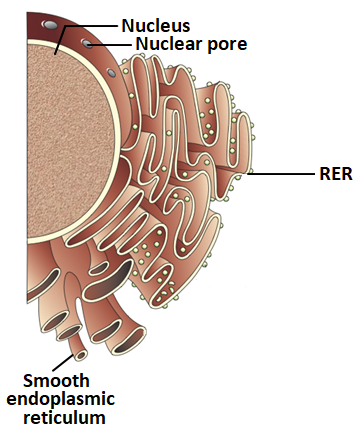
| 1. |
Golgi apparatus, protein synthesis |
| 2. |
Golgi apparatus, formation of amino acids |
| 3. |
Rough endoplasmic reticulum, protein synthesis |
| 4. |
Rough endoplasmic reticulum, formation of glycoproteins |
58. Identify the incorrect statement:
| 1. |
Cytosine is common for both DNA and RNA. |
| 2. |
Uracil is present in RNA at the place of Thymine. |
| 3. |
A nitrogenous base is linked to the OH of 1'C pentose sugar through a N-glycosidic linkage to form a nucleoside. |
| 4. |
When a phosphate group is linked to OH of 2'C of a nucleoside through phosphoester linkage, a corresponding nucleotide is formed. |
59. The activator of alcohol dehydrogenase enzyme is:
| 1. |
Zinc |
2. |
Magnesium |
| 3. |
Manganese |
4. |
Molybdenum |
60. The biomolecule shown in the given figure is:

| 1. |
an aromatic amino acid |
| 2. |
a zwitterion |
| 3. |
a substituted pyrimidine |
| 4. |
a substituted purine |
61. Consider the following statements:
| I: |
There is no uncatalysed metabolic conversion in living systems. |
| II: |
The living state is a non-equilibrium steady state to be able to perform work. |
| III: |
The living state and metabolism are synonyms, without metabolism there cannot be a living state. |
Which of the above statements are true?
1. I and II only
2. I and III only
3. II and III only
4. I, II and III
62. The fruit fly has 8 chromosomes (2n) in each cell. During the interphase of mitosis, if the number of chromosomes at G
1 phase is 8, what would be the number of chromosomes after the S phase?
63. Identify the meiotic stage in which the homologous chromosomes separate while the sister chromatids remain associated at their centromeres.
1. Metaphase-II
2. Anaphase-I
3. Anaphase-II
4. Metaphase-I
64. Select the wrong statement:
| 1. |
Bacterial cell wall is made up of peptidoglycan |
| 2. |
Pili and fimbriae are mainly involved in the motility of bacterial cells |
| 3. |
Cyanobacteria lack flagellated cells |
| 4. |
Mycoplasma is a wall-less microorganism |
65. Identify the incorrectly matched pair:
|
Type of epithelium |
Location |
| 1. |
Simple squamous |
Blood vessels and alveoli |
| 2. |
Simple cuboidal non brush bordered epithelium |
Proximal convoluted tubule |
| 3. |
Columnar epithelium |
Stomach and small intestine |
| 4. |
Ciliated epithelium |
Bronchioles and fallopian tubes |
66. Which of the following is true for nucleolus?
| 1. |
Larger nucleoli are present in dividing cells. |
| 2. |
It is a membrane-bound structure. |
| 3. |
It takes part in spindle formation. |
| 4. |
It is a site for active ribosomal RNA synthesis. |
67. Consider the following statements:
| I: |
In animal cells, lipid like steroidal hormones are synthesized in SER. |
| II: |
Golgi apparatus is the important site for formation of glycoproteins & glycolipids. |
| III: |
Lysosomes carry alkaline hydrolases. |
Which of the above statements are true?
1. I and II only
2. I and III only
3. II and III only
4. I, II and III
68. Centrosome:
| 1. |
is a non- membrane bound organelle found in all cells which helps in cell division |
| 2. |
is a non- membrane bound organelle found in plant cells which helps in cell division |
| 3. |
is a non- membrane bound organelle found in animal cells which helps in DNA replication |
| 4. |
is a non- membrane bound organelle found in animal cells which helps in cell division |
69. Consider the given two statements:
| Statement I: |
All prokaryotes have a cell wall surrounding the cell membrane except in mycoplasma. |
| Statement II: |
No organelles, like the ones in eukaryotes, are found in prokaryotic cells except for ribosomes. |
| 1. |
Statement I is correct; Statement II is correct |
| 2. |
Statement I is incorrect; Statement II is correct |
| 3. |
Statement I is correct; Statement II is incorrect |
| 4. |
Statement I is incorrect; Statement II is incorrect |
70. Identify the correct sequence of events during Prophase I of meiosis:
| (a) |
Synapsis of homologous chromosomes |
| (b) |
Chromosomes become gradually visible under microscope |
| (c) |
Crossing over between non-sister chromatids of homologous chromosomes |
| (d) |
Terminalisation of chiasmata |
| (e) |
Dissolution of synaptonemal complex |
Choose the correct answer from the options given below:
1. (a), (b), (c), (d), (e)
2. (b), (c), (d), (e), (a)
3. (b), (a), (c), (e), (d)
4. (a), (c), (d), (e), (b)
71. Unlike Arthropods, Annelids:
| 1. |
have a true coelom lined by embryonic mesoderm |
| 2. |
have a closed circulatory system |
| 3. |
do not reproduce by sexual methods |
| 4. |
have a complete digestive system |
72. In
Obelia:
| a: |
both polyp and medusa forms exist during its life cycle |
| b: |
metagenesis, a sort of alternation of generation, is seen |
| c: |
polyps produce medusae sexually and medusae form the polyps sexually |
| 1. |
only a is correct |
2. |
only a and b are correct |
| 3. |
only c is correct |
4. |
a, b and c are correct |
73. In the 24 hour average duration of cell cycle of a human cell, cell division properly lasts for:
| 1. |
only about 1 hour |
| 2. |
approximately 90 minutes |
| 3. |
between 4 and 5 hours |
| 4. |
95% time of the cell cycle |
74.
How many of the given statements regarding the anatomy of frogs are correct?
| A: |
Kidneys are situated a little posteriorly in the body cavity on both sides of the vertebral column. |
| B: |
Each kidney is composed of several structural and functional units called uriniferous tubules or nephrons. |
| C: |
Two ureters emerge from the kidneys in male frogs, where the ureters act as urinogenital ducts that open into the cloaca. |
| D: |
In females, the ureters and oviduct open separately in the cloaca. |
75. Match each item in Column I with one in Column II and select the correct match from the codes given:
|
Column I
[Structure of a prokaryotic cell] |
|
Column II
[Function] |
| A |
Mesosome |
P |
Attachment to the substrate |
| B |
Chromatophore |
Q |
Conjugation |
| C |
Fimbriae |
R |
Photosynthetic pigments |
| D |
Pili |
S |
DNA replication |
Codes:
|
A |
B |
C |
D |
| 1. |
S |
R |
P |
Q |
| 2. |
S |
R |
Q |
P |
| 3. |
R |
S |
Q |
P |
| 4. |
R |
S |
P |
Q |
76. Identify the incorrect match:
|
Structure of Cockroach |
Location |
| 1. |
Testes |
4-6th abdominal segments |
| 2. |
Mushroom gland |
8-9th abdominal segments |
| 3. |
Ovaries |
2-6th abdominal segments |
| 4. |
Spermatheca |
6th abdominal segment |
77. Choose the correct statement about a muscular tissue:
| 1. |
Skeletal muscle fibres are uninucleated and found in parallel bundles. |
| 2. |
Intercalated discs allow the skeletal muscle cells to contract as a unit. |
| 3. |
Skeletal muscles are striated and voluntary. |
| 4. |
Smooth muscles are multinucleated and involuntary |
78. Match each item in
Column-I with ONLY one in
Column-II and select the correct match from the codes given:
|
Column-I
[Structure in Cockroach] |
|
Column-II
[Location] |
| A |
Forewings |
P |
Prothorax |
| B |
Hind wings |
Q |
Mesothorax |
| C |
Anal cerci |
R |
Metathorax |
|
|
S |
10th segment but absent in females |
|
|
T |
10th segment and present in both sexes |
Codes:
|
A |
B |
C |
| 1. |
Q |
R |
S |
| 2. |
Q |
R |
T |
| 3. |
P |
Q |
S |
| 4. |
R |
R |
T |
79. In birds:
| a: |
the characteristic feature is the presence of feathers. |
| b: |
forelimbs are modified into wings. |
| c: |
flight is present in all members. |
| d: |
hind limbs do not have scales. |
| 1. |
Only (a) and (d) are incorrect |
| 2. |
Only (c) and (d) are correct |
| 3. |
(a), (b) and (c) are correct |
| 4. |
Only (a) and (b) are correct |
80. Given below are two statements:
| Assertion (A): |
Frogs help maintain ecological balance. |
| Reason (R): |
Frogs serve as an important link in the food chain and food web in the ecosystem. |
In the light of the above statements choose the correct answer from the options given below:
| 1. |
(A) is True but (R) is False. |
| 2. |
Both (A) and (R) are True but (R) is not the correct explanation of (A). |
| 3. |
Both (A) and (R) are True and (R) is the correct explanation of (A). |
| 4. |
(A) is False but (R) is True. |
81. A water vascular system is characteristically seen in animals belonging to the Phylum:
| 1. |
Porifera |
2. |
Ctenophora |
| 3. |
Echinodermata |
4. |
Hemichordata |
82. Which one of the following pair of animals comprises 'jawless fishes'?
| 1. |
Lampreys and eels |
| 2. |
Mackerals and rohu |
| 3. |
Lampreys and hagfishes |
| 4. |
Guppies and hagfishes |
83. Earth has amazing bio-diversity. The number of species on Earth that are known and described ranges between:
| 1. |
0.8 - 1.0 million |
2. |
1.7 - 1.8 million |
| 3. |
7 – 8 million |
4. |
20 – 50 million |
84. Given below are two statements:
| Statement I: |
A protein is imagined as a line, the left end represented by first amino acid (C-terminal) and the right end represented by last amino acid (N-terminal). |
| Statement II: |
Adult human haemoglobin, consists of 4 subunits (two subunits of \(\alpha\) type and two subunits of ẞ type.) |
In the light of the above statements, choose the correct answer from the options given below:
| 1. |
Statement I is false but Statement II is true. |
| 2. |
Both Statement I and Statement II are true. |
| 3. |
Both Statement I and Statement II are false. |
| 4. |
Statement I is true but Statement II is false. |
85. In the given diagrammatic representation of internal organs of a frog showing the complete digestive system, identify I, II, III, IV:

|
I |
II |
III |
IV |
| 1. |
Oesophagus |
Liver |
Gall bladder |
Fat bodies |
| 2. |
Pharynx |
Liver |
Gall bladder |
Uricose glands |
| 3. |
Buccal cavity |
Gall bladder |
Liver |
Antennal glands |
| 4. |
Oesophagus |
Gall bladder |
Liver |
Fat bodies |
Zoology - Section B
86. Consider the given two statements:
| Statement 1: |
Hemichordates were earlier considered as a sub-phylum under Phylum Chordata but are now placed separately in a phylum under non-Chordata. |
| Statement 2: |
Hemichordates have a rudimentary structure in the collar region called stomochord, a structure homologous to the notochord. |
| 1. |
Both Statement 1 and Statement 2 are correct but Statement 2 does not explain Statement 1. |
| 2. |
Statement 1 is correct and Statement 2 is incorrect. |
| 3. |
Both Statement 1 and Statement 2 are incorrect. |
| 4. |
Both Statement 1 and Statement 2 are correct and Statement 2 explains Statement 1. |
87. Which one of the following phyla is correctly matched with its two general characteristics?
| 1. |
Arthropoda - The body is divided into a head, thorax, abdomen and respiration by mouth |
| 2. |
Chordata - Notochord at some stage and separate anal and urinary openings to the outside |
| 3. |
Echinodermata – Pentamerous radial symmetry and mostly internal fertilization |
| 4. |
Mollusca - Normally oviparous and developed through a trochophore or veliger larva |
88.
An animal with the following body wall organization will not have:

1. Cephalization
2. Three germ layers
3. Bilateral symmetry
4. A complete digestive tract
89. Identify the correct statements:
| Statement I: |
Frog eye does not have closable eye lids. |
| Statement II: |
A nictitating membrane provides protection to the eye, especially when the frog is swimming. |
1.
Statement I is correct;
Statement II is incorrect
2.
Statement I is incorrect;
Statement II is incorrect
3.
Statement I is correct;
Statement II is correct
4.
Statement I is incorrect;
Statement II is correct
90. Being cold-blooded, frogs have to adopt suitable behaviour patterns to regulate their temperature.
Which of the following will be true?
| I: |
To warm up, they can move into the sun or onto a warm surface; if they overheat, they can move into the shade. |
| II: |
In cool damp conditions, the colour of the skin will be lighter than on a hot dry day. |
1.
Statement I is correct;
Statement II is incorrect
2.
Statement I is correct;
Statement II is correct
3.
Statement I is incorrect;
Statement II is incorrect
4.
Statement I is incorrect;
Statement II is correct
91. In the given diagram of areolar tissue, identify a phagocytic cell:

92. Consider the given two statements:
| Assertion (A): |
Lipids come under acid insoluble fraction of the cell. |
| Reason (R): |
Acid insoluble fraction is the macromolecular fraction and lipids are macromolecules. |
| 1. |
(A) is True but (R) is False |
| 2. |
Both (A) and (R) are True and (R) correctly explains (A) |
| 3. |
Both (A) and (R) are True and but (R) does not correctly explain (A) |
| 4. |
(A) is False but (R) is True |
93. Rates of physical and chemical processes are influenced by temperature among other factors. A general rule of thumb is that rate:
| 1. |
doubles by half for every 10°C change in either direction |
| 2. |
decreases by half for every 10°C change in either direction |
| 3. |
doubles or decreases by half for every 10°C change in either direction |
| 4. |
doubles or decreases by half for every 5°C change in either direction |
94. Consider the given two statements:
| Statement I: |
Periplaneta americana is dioecious. |
| Statement II: |
The development of Periplaneta americana is holometabolous. |
| 1. |
Statement I is correct; Statement II is correct |
| 2. |
Statement I is incorrect; Statement II is correct |
| 3. |
Statement I is correct; Statement II is incorrect |
| 4. |
Statement I is incorrect; Statement II is incorrect |
95. A ‘sea-horse’ is a:
| 1. |
marine bony fish |
| 2. |
fresh water bony fish |
| 3. |
cartilaginous fish |
| 4. |
cyclostome |
96. Which of the following statements is not correct?
| 1. |
Lysosomes are formed by the process of packaging in the endoplasmic reticulum. |
| 2. |
Lysosomes have numerous hydrolytic enzymes |
| 3. |
The hydrolytic enzyme of lysosomes are active under acidic pH |
| 4. |
Lysosomes are membrane bound structure. |
97. The members of which of the following animal phyla are not exclusively marine?
1. Porifera
2. Ctenophora
3. Echinodermata
4. Hemichordata
98. Which of the following is not a characteristic of Amphibians?
| 1. |
Most have two pairs of limbs and tail is present in some. |
| 2. |
Alimentary canal, urinary and reproductive tracts open into a common chamber called cloaca which opens to the exterior. |
| 3. |
Respiration is by gills, lungs and through skin. |
| 4. |
The heart is two chambered with one atrium and one ventricle. |
99. Enzymes that catalyze removal of groups from substrates by mechanisms other than hydrolysis leaving double bonds are:
| 1. |
Dehygdrogenases |
2. |
Transferases |
| 3. |
Lyases |
4. |
Ligases |
100. Consider the two statements:
| Statement I: |
The interphase represents the phase between two successive M phases and DNA replication takes place in the interphase. |
| Statement II: |
The stage between the two meiotic divisions is called interkinesis and there is no replication of DNA during interkinesis. |
| 1. |
Statement I is correct; Statement II is correct |
| 2. |
Statement I is correct; Statement II is incorrect |
| 3. |
Statement I is incorrect; Statement II is correct |
| 4. |
Statement I is incorrect; Statement II is incorrect |
*If above link doesn't work, please go to test link from where you got the pdf and fill OMR from there
CLICK HERE to get FREE ACCESS for 2 days of ANY NEETprep course
 Biology Prodigy Test #2 (Part Test) - NEET 2024Contact Number: 8527521718


