Botany - Section A
1. What is the direction of the micropyle in the anatropous ovule:
| 1. |
Upward |
2. |
Downward |
| 3. |
Right |
4. |
Left |
2. Seeds offer several advantages to angiosperms. Which of the following is not one?
1. The process is more dependable
2. Better adaptive strategies for dispersal
3. Protection of the young embryo
4. Genetic uniformity
3. Plants have developed many mechanisms to encourage cross-pollination that include:
| I: |
Asynchrony between pollen release and stigma receptivity |
| II: |
Placing of pollen and stigma at different positions |
| III: |
Self-incompatibility |
| IV: |
Dioecy |
What would be true regarding these mechanisms?
| 1. |
I and II prevent autogamy and geitonogamy |
| 2. |
III is a genetic mechanism that inhibits pollen germination or pollen tube growth |
| 3. |
IV is a very common [found in the majority] mechanism seen in flowering plants |
| 4. |
I, II, and III invariably lead to xenogamy |
4. Three air-dried bean seeds are tied to a glass slide with two [A and C in the fig.] at the two ends and one [B] in the middle. This slide is placed in a beaker with the middle seed half immersed in water as shown in the fig. The water level is kept constant throughout the experiment. Which seed/s is/are expected to germinate normally?

| 1. |
Only A |
2. |
Only B |
| 3. |
Only B and C |
4. |
Only A and C |
5. In Pisum sativum, Mendel studied:
1. 7 characters and 7 contrasting traits
2. 7 characters and 14 contrasting traits
3. 14 characters and 7 contrasting traits
4. 14 characters and 14 contrasting traits
6. Flowers which have single ovule in the ovary and are packed into inflorescence are usually pollinated by:
| 1. |
Bee |
2. |
Wind |
| 3. |
Bat |
4. |
Water |
7. Identify the incorrect statement:
| 1. |
The template strand in a transcription unit is copied to an mRNA. |
| 2. |
Split gene arrangement is characteristic of prokaryotes. |
| 3. |
In capping, methylguanosine triphosphate is added to the 5' end of hnRNA. |
| 4. |
RNA polymerase binds with the Rho factor to terminate the process of transcription in bacteria. |
8. Regarding DNA replication:
| I: |
It is semi-conservative. |
| II: |
It is semi-discontinuous. |
1. Only
I is correct
2. Only
II is correct
3. Both
I and
II are correct
4. Both
I and
II are incorrect
9. For the stability of the organic compounds, Oparin opined that, probably:
| 1. |
UV radiation never reached the surface of the primeval Earth |
| 2. |
the primeval Earth was in a molten state |
| 3. |
the primeval Earth atmosphere was reducing rather than oxidizing |
| 4. |
plenty of energy sources were available for chemical reactions to occur |
10. All the following are recessive traits in
Pisum sativum except:
| 1. |
Green pod colour |
| 2. |
Green seed colour |
| 3. |
Terminal flower position |
| 4. |
Constricted pod shape |
11. Consider the following statements:
| I: |
A monoecious plant bears either male or female flowers. |
| II: |
In monoecious plants, autogamy may be prevented but not geitonogamy. |
| III: |
Cucurbits and coconuts are monoecious plants. |
Which of the above statements are true?
| 1. |
I and II only |
2. |
I and III only |
| 3. |
II and III only |
4. |
I, II, and III |
12. Which histone is not a part of the octamer that forms the core of histone molecules in a nucleosome?
1. H1
2. H2A
3. H2B
3. H3
13. Prior to the work of Avery, Macleod, and McCarty, the genetic material was thought to be:
| 1. |
DNA |
2. |
RNA |
| 3. |
Protein |
4. |
Nucleotide |
14. Consider the two statements:
| Assertion (A): |
When Griffith injected a mixture of heat-killed S and live R bacteria, the mice died. |
| Reason (R): |
Mice infected with the S strain (virulent) die from pneumonia infection but mice infected with the R strain do not develop pneumonia. |
| 1. |
Both (A) and (R) are True and (R) is the correct explanation of (A). |
| 2. |
Both (A) and (R) are True but (R) is not the correct explanation of (A). |
| 3. |
(A) is True but (R) is False. |
| 4. |
Both (A) and (R) are False. |
15. Match terms in
Column-I with their description in
Column-II and select the correct match from the codes given:
|
Column-II |
|
Column-II |
| A. |
Saltation |
P. |
The diversification of a group of organisms into forms filling different ecological niches. |
| B. |
Adaptive radiation |
Q. |
Descent with modification. |
| C. |
Natural selection |
R. |
Single step large mutation. |
| D. |
Evolution |
S. |
Differential reproduction. |
Codes:
|
A |
B |
C |
D |
| 1. |
P |
R |
Q |
S |
| 2. |
R |
P |
Q |
S |
| 3. |
R |
P |
S |
Q |
| 4. |
P |
R |
S |
Q |
16. What will be the ploidy of endosperm of a seed produced after crossing tetraploid female plant with tetraploid male plant?
1. Pentaploid
2. Hexaploid
3. Diploid
4. Triploid
17. Male gametophyte in angiosperms produces?
1. Two sperms and a vegetative cell
2. Single sperm and a vegetative cell
3. Single sperm and two vegetative cells
4. Three sperms
18. Consider the two statements:
| Assertion (A): |
Transcription and translation can be coupled in bacteria. |
| Reason (R): |
The peptide bond formation in prokaryotes is catalysed by a ribozyme.
|
| 1. |
Both (A) and (R) are True but (R) does not correctly explain (A) |
| 2. |
(A) is True but (R) is False. |
| 3. |
Both (A) and (R) are False. |
| 4. |
Both (A) and (R) are True and (R) correctly explains (A) |
19. The two alleles of a gene pair are located on:
| 1. |
homologous sites on homologous chromosomes |
| 2. |
homologous sites on heterologous chromosomes |
| 3. |
heterologous sites on homologous chromosomes |
| 4. |
heterologous sites on heterologous chromosomes |
20. A gene locus has two alleles A, a. If the frequency of dominant allele A is 0.3, then what will be the frequency of homozygous dominant individuals in the population?
| 1. |
0.7 |
2. |
0.09 |
| 3. |
0.42 |
4. |
0.49 |
21. The predominant site for the control of gene expression in prokaryotes is:
1. Transcription initiation
2. Processing of hnRNA
3. Translational level
4. Post translational modification
22. Consider the two given statements:
| Statement I: |
Gynoecium of Papaver is multicarpellary and apocarpous. |
| Statement II: |
Gynoecium of Michelia is multicarpellary and syncarpous. |
| 1. |
Statement I is correct; Statement II is incorrect |
| 2. |
Statement I is correct; Statement II is correct |
| 3. |
Statement I is incorrect; Statement II is incorrect |
| 4. |
Statement I is incorrect; Statement II is correct |
23. Given below are two statements : one is labelled as Assertion
(A) and the other is labelled as Reason
(R).
| Assertion (A): |
Transcription and translation can be coupled in bacteria. |
| Reason (R): |
In bacteria, the mRNA does not require any processing to become active, and also transcription and translation take place in the same compartment. |
In the light of the above statements, choose the most appropriate answer from the options given below :
| 1. |
Both (A) and (R) are True but (R) is not the correct explanation of (A). |
| 2. |
Both (A) and (R) are False. |
| 3. |
Both (A) and (R) are True and (R) is the correct explanation of (A). |
| 4. |
(A) is True but (R) is False. |
24. Zea mays have 20 chromosomes in its somatic cell. The number of chromosomes in its endosperm will be:
25. All the following plants are pollinated by water except:
1. Vallisneria
2. Hydrilla
3. Zostera
4. Eicchornia
26. In some members of which of the following pairs of families, pollen grains retain their viability for months after release?
1. Poaceae; Solanaceae
2. Rosaceae; Leguminosae
3. Poaceae; Rosaceae
4. Poaceae; Leguminosae
27. From his experiments, S.L. Miller produced amino acids by mixing which of the following in a closed flask:
1. and water vapour at
2. and water vapour at
3. and water vapour at
4. and water vapour at
28. Consider the following statements:
| I: |
Nature selects for fitness. |
| II: |
Fitness is based on characteristics that are inherited. |
| III: |
Fitness is the end result of the ability to adapt and get selected by nature. |
Which of the above statements are true?
1.
I and
II only
2.
I and
III only
3.
II and
III only
4.
I,
II, and
III
29. In artificial hybridisation for crop improvement, if the female parent produces unisexual flowers, there is no need for:
| I: |
Emasculation |
| II: |
Bagging |
1. Only
I
2. Only
II
3. Both
I and
II
4. Neither
I nor
II
30. Which one of the following statements regarding post-fertilization development in flowering plants is incorrect?
| 1. |
Ovules develop into an embryo sac |
| 2. |
Ovary develops into fruit |
| 3. |
Zygote develops into an embryo |
| 4. |
Central cell develops into endosperm |
31. Given below are two statements : one is labelled as Assertion
(A) and the other is labelled as Reason
(R).
| Assertion (A): |
In Avery, Macleod, and McCarty's experiment, digestion of heat-killed lysate with proteases and RNases did not affect transformation but digestion with DNase did. |
| Reason (R): |
DNase will hydrolyse all biomolecules in the lysate except DNA. |
In the light of the above statements, choose the most appropriate answer from the options given below :
| 1. |
(A) is True but (R) is False. |
| 2. |
Both (A) and (R) are True and (R) is the correct explanation of (A). |
| 3. |
Both (A) and (R) are True but (R) is not the correct explanation of (A). |
| 4. |
Both (A) and (R) are False. |
32. “Chromosomes, which are seen in all dividing cells and pass from one generation to the next, are the basis for all genetic inheritance”.
This statement is credited to:
| 1. |
Watson and Crick |
2. |
Hershey and Chase |
| 3. |
Sutton and Boveri |
4. |
Meselson and Stahl
|
33. Consider the given two statements:
| Assertion (A): |
DNA and not RNA are preferred for the storage of genetic information. |
| Reason (R): |
DNA chemically is less reactive and structurally more stable when compared to RNA. |
| 1. |
(A) is True but (R) is False. |
| 2. |
Both (A) and (R) are True but (R) does not correctly explain (A). |
| 3. |
Both (A) and (R) are True and (R) correctly explains (A). |
| 4. |
(A) is False but (R) is True. |
34. What is the role of RNA polymerase II in the process of transcription in eukaryotes?
1. Transcribes precursor of mRNA
2. Transcribes only snRNAs
3. Transcribes rRNAs (28S, 18S and 5.8S)
4. Transcribes tRNA, 5s rRNA and snRNA
35. Given below are two statements : one is labelled as Assertion
(A) and the other is labelled as Reason
(R).
| Assertion (A): |
Lactose is the inducer of the lac operon in E.coli. |
| Reason (R): |
Lactose is the inhibitor of the lac operon. |
In the light of the above statements, choose the most appropriate answer from the options given below :
| 1. |
Both (A) and (R) are True and (R) is the correct explanation of (A). |
| 2. |
Both (A) and (R) are False. |
| 3. |
Both (A) and (R) are True but (R) is not the correct explanation of (A). |
| 4. |
(A) is True but (R) is False. |
Botany - Section B
36. Study the results of the Meselson and Stahl experiment. What theoretically possible mode of DNA replication can be excluded after one round of replication?

1. Conservative
2. Semiconservative
3. Disruptive
4. Both 1 and 3
37. In
Pisum sativum, the allele for tallness [
T] is completely dominant over the allele for dwarfness [
t]. What proportion of the tall progeny of the cross
Tt X
Tt will be homozygous tall?
| 1. |
1/3 |
2. |
1/4 |
| 3. |
1/2 |
4. |
3/2 |
38. The sequence on the template strand of DNA which will be responsible for the insertion of the first amino acid into a protein will be:
| 1. |
TAC |
2. |
AUG |
| 3. |
CAT |
4. |
ACT |
39. If a sample of single stranded DNA contains 23 % adenine bases of total, what is the expected percentage of guanine bases in this sample of DNA?
| 1. |
23 |
| 2. |
27 |
| 3. |
46 |
| 4. |
Cannot be determined on the basis of information given |
40. Match each item in
Column-I with one in
Column-II and select the correct match from the codes given [assume independent assortment wherever applicable]:
|
Column-I |
|
Column-II |
| A. |
Number of types of genotypes in F2 progeny of a dihybrid cross |
P. |
4 |
| B. |
Number of types of phenotypes in a dihybrid test cross |
Q. |
9 |
| C. |
Number of types of phenotypes in F2 progeny in three polygenes |
R. |
7 |
|
|
S. |
8 |
Codes:
|
A |
B |
C |
| 1. |
Q |
P |
S |
| 2. |
Q |
P |
R |
| 3. |
P |
Q |
R |
| 4. |
P |
Q |
S |
41. Incomplete dominance results in:
| 1. |
Offspring having a trait identical to one of the parents. |
| 2. |
Offspring having a trait that is a blend of those seen in the parents. |
| 3. |
Offspring having a trait similar but not identical to one of the parents. |
| 4. |
Offspring having a different trait than both parents. |
42. After a mutation at a genetic locus, the character of an organism changes due to the change in:
1. DNA replication
2. Protein synthesis pattern
3. RNA transcription pattern
4. Protein structure
43. If each strand of a dsDNA acts as a template for a new strand, the two daughter DNAs will be:
| 1. |
Complementary to each other |
| 2. |
Identical to the parental DNA |
| 3. |
Similar to each other |
| 4. |
Complementary to the parental DNA |
44. Due to the discovery of which of the following in 1980, the evolution was termed as RNA world?
| 1. |
m-RNA, t-RNA- rRNA synthesize proteins |
| 2. |
In some viruses, RNA is the genetic material |
| 3. |
RNA has enzymatic property |
| 4. |
RNA is not found in all cells |
45. Which radioactive isotope was used by Meselson and Stahl to label DNA in their experiment?
1. 35S
2. 15N
3. 32P
4. None
46. Pollens grains are long ribbon-like and are carried passively in water in:
| 1. |
female plants remain submerged in water |
| 2. |
male plants remain submerged in water |
| 3. |
both male and female plants remain submerged in water |
| 4. |
both male and female plants reach the surface of the water. |
47. In a cross between a pea plant that has seeds with yellow colour and round shape and one that has seeds of green colour and wrinkled shape, the yellow and green colours are segregated in a:
1. 1 : 1 ratio
2. 3 : 1 ratio
3. 9 : 3 : 3 : 1 ratio
4. 1 : 1 : 1 : 1 ratio
48. A typical angiosperm anther in transverse section will show:
| 1. |
two lobes, each lobe having two theca and each theca having two microsporangia |
| 2. |
two lobes, each lobe having two theca and each theca having four microsporangia |
| 3. |
two lobes, each lobe having two theca and each lobe having two microsporangia |
| 4. |
two lobes, each lobe having two theca and each lobe having four microsporangia |
49. An individual with c and d genes was crossed with the wild type ++. On test crossing F1, the progeny were +c 105, +d 115, cd 880 and ++900. Distance between c and d genes is:
| 1. |
11 map units |
2. |
5.5 map units |
| 3. |
44 map units |
4. |
22 map units |
50. Hair found in the inflorescences of Zea mays is the modification of:
| 1. |
Style |
2. |
Stigma |
| 3. |
Spathe |
4. |
Filaments |
Zoology - Section A
51. Which one of the following statements about human sperm is correct?
| 1. |
The acrosome has a conical, pointed structure used for piercing and penetrating the egg, resulting in fertilization. |
| 2. |
The sperm lysins in the acrosome dissolve the egg envelope, facilitating fertilization. |
| 3. |
The acrosome serves as a sensory structure, leading the sperm towards the ovum. |
| 4. |
The acrosome serves no particular function. |
52. Which one of the following is the correct match of the events occurring during the menstrual cycle?
| 1. |
Ovulation - LH and FSH attain peak level and sharp fall in the secretion of progesterone |
| 2. |
Proliferative phase - Rapid regeneration of myometrium and maturation of Graafian follicle |
| 3. |
Development of corpus luteum - Secretory phase and increased secretion of progesterone |
| 4. |
Menstruation - Breakdown of myometrium and ovum not fertilized |
53. Consider the two statements:
| Assertion(A): |
Periodic abstinence is the method of natural contraception in which the couples avoid or abstain from coitus from day 10 to 17 of the menstrual cycle. |
| Reason(R): |
Implantation is expected to take place from day 10 to 17 of the menstrual cycle. |
| 1. |
Both (A) and (R) are True but (R) does not correctly explain (A). |
| 2. |
(A) is True but (R) is False. |
| 3. |
Both (A) and (R) are False. |
| 4. |
Both (A) and (R) are True and (R) correctly explains (A). |
54. Consider the two statements:
| Statement I: |
Saheli is a ‘once a week’ pill with very few side effects and high contraceptive value. |
| Statement II: |
Multiload 375 is a hormone-releasing IUD. |
| 1. |
Statement I is correct; Statement II is correct |
| 2. |
Statement I is correct; Statement II is incorrect |
| 3. |
Statement I is incorrect; Statement II is correct |
| 4. |
Statement I is incorrect; Statement II is incorrect |
55. In case of a couple where the male is having a very low sperm count, which technique will be suitable for fertilization?
| 1. |
Gamete intracytoplasmic fallopian transfer |
| 2. |
Artificial insemination |
| 3. |
Intracytoplasmic sperm injection |
| 4. |
Intrauterine transfer |
56. Which of the following depicts the correct pathway of transport of sperms?
| 1. |
Rete testis → Efferent ductules → Epididymis → Vas deferens |
| 2. |
Rete testis → Epididymis → Efferent ductules → Vas deferens |
| 3. |
Rete testis → Vas deferens → Efferent ductules → Epididymis |
| 4. |
Efferent ductules → Rete testis → Vas deferens → Epididymis |
57. Spermatogenesis starts at the age of puberty due to a significant increase in the secretion of:
1. GnRH
2. FSH
3. LH
4. Testosterone
58. Though we cannot be certain, what can be the probable reason/s for the sudden disappearance of dinosaurs from the Earth?
| I: |
Climatic changes killed them |
| II: |
Most of them evolved into birds |
| 1. |
I only |
2. |
II only |
| 3. |
Both I and II |
4. |
Neither I nor II |
59. The difference between spermiogenesis and spermiation is?
| 1. |
In spermiogenesis, spermatids are formed, while in spermiation, spermatozoa are formed. |
| 2. |
In spermiogenesis, spermatozoa are formed, while in spermiation, spermatids are formed. |
| 3. |
In spermiogenesis, spermatozoa from Sertoli cells are released into the cavity of seminiferous tubules, while in spermiation, spermatozoa are formed. |
| 4. |
In spermiogenesis, spermatozoa are formed, while in spermiation, spermatozoa are released from Sertoli cells into the cavity of seminiferous tubules. |
60. Match each item in Column I with one in Column II regarding salient features of human genome and select the correct match from the codes given:
|
Column I |
|
Column II |
| A |
SNP |
P |
231 |
| B |
Number of genes on chromosome 1 |
Q |
2968 |
| C |
Percent of the genome that codes for proteins |
R |
3.9 million locations |
|
|
S |
1.4 million location |
|
|
T |
Less than 2 |
|
|
U |
More than 50 |
Codes:
|
A |
B |
C |
| 1. |
S |
Q |
U |
| 2. |
R |
Q |
T |
| 3. |
S |
P |
T |
| 4. |
S |
Q |
T |
61. Study the pedigree chart given below:
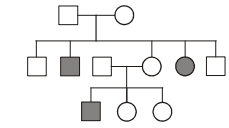
What does it show?
| 1. |
Inheritance of a sex-linked inborn error of metabolism |
| 2. |
Inheritance of a condition like phenylketonuria as an
autosomal recessive trait |
| 3. |
The pedigree chart is wrong as this is not possible |
| 4. |
Inheritance of a recessive sex-linked disease like
haemophilia |
62. The correct sequence of mammalian mammary gland ducts beginning from the alveoli would be:
| 1. |
Mammary tubules → Mammary ducts → Mammary ampulla → Lactiferous ducts |
| 2. |
Lactiferous ducts → Mammary ducts → Mammary ampulla → Mammary tubules |
| 3. |
Lactiferous ducts → Mammary ampulla → Mammary ducts → Mammary tubules |
| 4. |
Mammary tubules → Mammary ampulla → Mammary ducts → Lactiferous ducts |
63. Regarding early embryonic development in humans:
| I: |
The first movements of the foetus and appearance of hair on the head are usually observed during the third month. |
| II: |
By the end of about 24 weeks, the body is covered with fine hair, eye-lids separate, and eyelashes are formed. |
1. Only
I is correct
2. Only
II is correct
3. Both
I and
II are correct
4. Both
I and
II are incorrect
64. Match each item in Column I with one in Column II and select your answer from the codes given:
|
Column I
|
|
Column II
|
| A. |
IUI
|
a. |
injection of washed sperm into the uterus with a catheter
|
| B. |
ZIFT
|
b. |
an egg fertilized in vitro (outside the body) is placed into a woman's fallopian tube
|
| C. |
GIFT
|
c. |
eggs are removed from a woman's ovaries, and placed in one of the Fallopian tubes, along with the man's sperm
|
| D. |
ICSI
|
d. |
injection of a single sperm directly into a mature egg
|
Codes :
|
A |
B |
C |
D |
| 1. |
a |
b |
c |
d |
| 2. |
d |
b |
c |
a |
| 3. |
a |
c |
b |
d |
| 4. |
d |
c |
b |
a |
65. Morgan, in his experiment on fruit flies, found that the genes white and yellow were very tightly linked and showed:
| 1. |
50 % recombination |
2. |
37.2 % recombination |
| 3. |
12.5 % recombination |
4. |
1.3 % recombination
|
66. Each ejaculatory duct is formed by the union of:
| 1. |
the vas deferens with the duct of the bulbourethral gland |
| 2. |
the vas deferens with the duct of the seminal vesicle |
| 3. |
the epididymis and the vas deferens |
| 4. |
the duct of bulbourethral gland and the urethra |
67. Leydig cells synthesize androgens under the direct influence of:
| 1. |
FSH |
2. |
LH |
| 3. |
FSH and LH |
4. |
GnRH |
68. The earlier technique of DNA fingerprinting involved Southern blot and all the following except:
| 1. |
digestion of DNA by deoxyribonuclease |
| 2. |
separation of DNA fragments by electrophoresis |
| 3. |
hybridisation using labelled VNTR probe |
| 4. |
detection of hybridised DNA fragments by autoradiography |
69. A process in which heritable variations enabling better survival are enabled to reproduce and leave greater number of progeny is called:
| 1. |
Evolution |
2. |
Saltation |
| 3. |
Speciation |
4. |
Natural selection |
70. Which of the following is not true for
Homo erectus?
| 1. |
Fossils discovered in Java |
| 2. |
Lived about 1.5 mya |
| 3. |
Had a large brain around 900cc |
| 4. |
Probably, did not eat meat |
71. Match each item in Column I with one in Column II and select the correct match from the codes given:
|
Column I |
|
Column II |
| A |
Syphilis |
P |
Protozoan STI |
| B |
Trichomoniasis |
Q |
Bacterial STI |
| C |
LNG-20 |
R |
Hormone releasing IUD |
| D |
Multiload 375 |
S |
Copper releasing IUD |
Codes:
|
A |
B |
C |
D |
| 1. |
Q |
P |
S |
R |
| 2. |
P |
Q |
R |
S |
| 3. |
P |
Q |
S |
R |
| 4. |
Q |
P |
R |
S |
72. A man and a woman, who do not show any apparent signs of a certain inherited disease, have seven children (2 daughters and 5 sons). Three of the sons suffer from the given disease but none of the daughters are affected. Which of the following mode of inheritance might be the reason for this disease?
| 1. |
Sex-limited recessive
|
2. |
Autosomal dominant
|
| 3. |
Sex-linked recessive
|
4. |
Sex-linked dominant
|
73. Genetic Drift operates in:
1. small isolated population
2. large isolated population
3. non-reproductive population
4. slow reproductive population
74. If a woman who is a known carrier for the gene of colour blindness marries a normal male, what percent of her male progeny are expected to be affected by the condition?
1. 0
2. 25
3. 50
4. 100
75. Pick out the correct statements:
| I: |
Haemophilia is a sex-linked recessive disease. |
| II: |
Down’s syndrome is due to aneuploidy. |
| III: |
Phenylketonuria is an autosomal recessive gene disorder. |
| IV: |
Sickle cell anaemia is an X-linked recessive gene disorder |
1.
II and
IV are correct
2.
I,
III and
IV are correct
3.
I,
II and
III are correct
4.
I and
IV are correct
76. Consider the following statements:
| I: |
Menstruation only occurs if the released ovum is not fertilized. |
| II: |
Lack of menstruation always indicates pregnancy. |
Of the given statements, the correct statements is/are:
| 1. |
I only |
2. |
II only |
| 3. |
I and II |
4. |
None |
77. Identify the correct statement:
| 1. |
Evolution by natural selection works best on a population having no variation. |
| 2. |
Mutation is a relatively unimportant source of variation and is not the foundation for evolution. |
| 3. |
The effects of genetic drift are most apparent in small populations. |
| 4. |
Inbreeding increases the proportion of heterozygous individuals in a population. |
78. Match each item in Column I with one in Column II and select the correct match from the codes given:
|
Column I |
|
Column II |
| A |
Leydig cells |
P |
The process by which sperms are released from the Sertoli cells into the lumen of seminiferous tubule |
| B |
Sertoli cells |
Q |
Transformation of spermatids into sperms |
| C |
Spermiation |
R |
Secrete androgen |
| D |
Spermiogenesis |
S |
Secrete inhibin |
Codes:
|
A |
B |
C |
D |
| 1. |
R |
S |
P |
Q |
| 2. |
R |
S |
Q |
P |
| 3. |
S |
R |
Q |
P |
| 4. |
S |
R |
P |
Q |
79. The wings of birds, the forelegs of a horse, and the upper limbs of humans are:
| 1. |
analogous structures |
2. |
homologous structures |
| 3. |
vestigial structures |
4. |
phylogenetic structures |
80. There is now enough evidence to suggest that essential life processes (such as metabolism, translation, splicing, etc.), evolved around:
| 1. |
DNA |
2. |
RNA |
| 3. |
Proteins |
4. |
Lipids |
81. Consider the two given statements:
| Assertion (A): |
Today, DNA from a single cell is enough to perform DNA fingerprinting analysis. |
| Reason (R): |
The use of PCR has increased the sensitivity of DNA fingerprinting. |
| 1. |
Both (A) and (R) are True and (R) correctly explains (A) |
| 2. |
(A) is True but (R) is False |
| 3. |
(A) is False but (R) is True |
| 4. |
Both (A) and (R) are True but (R) does not correctly explain (A) |
82. For effective contraception, oral contraceptive pills are started:
| 1. |
within the first five days of menstrual cycle |
| 2. |
during the proliferative phase of menstrual cycle |
| 3. |
around the time of ovulation |
| 4. |
anytime in the luteal phase of menstrual cycle |
83. Which of the following sexually transmitted infections is completely curable if diagnosed and treated early?
| 1. |
Hepatitis B |
2. |
Syphilis |
| 3. |
Genital herpes |
4. |
HIV
|
84. The increasing population of India is probably due to a decline in all of the following except:
| 1. |
death rate |
| 2. |
maternal mortality rate (MMR) |
| 3. |
infant mortality rate (IMR) |
| 4. |
number of people in reproducible age |
85. In humans, the sex of the baby is determined:
| 1. |
At the time of fertilization and by the father |
| 2. |
At the time of fertilization and by the mother |
| 3. |
At the time of implantation and by the father |
| 4. |
At the time of implantation and by the mother |
Zoology - Section B
86. Adaptations for evolutionary significance:
| 1. |
develop throughout the lifetime of organisms and are then passed on to their offspring |
| 2. |
develop after a population encounters a change in environment |
| 3. |
are inherited characteristics |
| 4. |
decrease the chances of the organism surviving until maturity |
87. Consider the following statements:
| I: |
The uterine endometrium undergoes cyclical changes during the menstrual cycle. |
| II: |
Estrogen secreted during the pre-ovulatory phase of the menstrual cycle helps in the development of follicle. |
| III: |
hCG secreted by trophoblast cells helps in maintaining corpus luteum. |
Which of the above statements are true?
1.
I and
II only
2.
I and
III only
3.
II and
III only
4.
I,
II, and
III
88. The pedigree shows the inheritance of red-green color blindness in a family. If II 3 marries a color-blind man, what is the probability that her first child will be normal?

89. In a random mating population in equilibrium, which of the following brings about a change in gene frequency in a non-directional manner?
| 1. |
Mutations |
2. |
Random drift |
| 3. |
Selection |
4. |
Migration |
90. Which one of the following sequences was proposed by Darwin and Wallace for organic evolution?
| 1. |
Overproduction, variations, constancy of population size, natural selection |
| 2. |
Variations, constancy of population size, overproduction, natural selection |
| 3. |
Overproduction, constancy of population size, variations, natural selection |
| 4. |
Variations, natural selection, overproduction, constancy of population size |
91. DNA fingerprinting refers to:
| 1. |
Analysis of DNA samples using imprinting devices |
| 2. |
Techniques used for molecular analysis of different specimens of DNA |
| 3. |
Techniques used for the identification of fingerprints of individuals |
| 4. |
Molecular analysis of profiles of DNA samples |
92. Consider the following statements:
| I: |
The male barrier contraceptives provide protection against STDs. |
| II: |
Oral contraceptive pills (OCPs) are the contraceptive method used more commonly by urban women in India. |
| III: |
The second-generation IUDs release copper and the third-generation IUDs release hormones. |
Which of the above statements are true?
| 1. |
I and II only |
2. |
I and III only |
| 3. |
II and III only |
4. |
I, II, and III |
93. Consider the following statements:
| I: |
The primary follicles present at birth carry primary oocytes arrested at meiosis I. |
| II: |
The secondary oocyte arrested at meiosis II is released at ovulation. |
| III: |
The second meiotic division is completed by the secondary oocyte just prior to the entry of the sperm into it. |
Which of the above statements are true?
| 1. |
I and II only |
2. |
I and III only |
| 3. |
II and III only |
4. |
I, II, and III |
94. Consider the given statements:
| Assertion (A): |
Even if a character shows multiple allelism, an individual will only have two alleles for that character. |
| Reason (R): |
The somatic cells of an individual have only two chromosomes. |
| 1. |
(A) is True but (R) is False. |
| 2. |
Both (A) and (R) are True and (R) correctly explains (A). |
| 3. |
Both (A) and (R) are True but (R) does not correctly explain (A). |
| 4. |
(A) is False but (R) is True. |
95. Consider the two statements:
| Assertion (A): |
As long as the mother breast-feeds the child fully, chances of conception are almost nil upto six months following parturition. |
| Reason (R): |
Although ovulation occurs, the endometrium does not undergo any change during the period of intense lactation following parturition. |
| 1. |
Both (A) and (R) are True and (R) is the correct explanation of (A). |
| 2. |
Both (A) and (R) are True but (R) is not the correct explanation of (A). |
| 3. |
(A) is True but (R) is False. |
| 4. |
Both (A) and (R) are False. |
96. Which of these is not an important component of the initiation of parturition in humans?
1. Increase in oestrogen and progesterone ratio
2. Synthesis of prostaglandins
3. Release of oxytocin
4. Release of prolactin
97. What is released at the time of ovulation?
1. Primary oocyte arrested at meiosis I
2. Primary oocyte arrested at meiosis II
3. Secondary oocyte arrested at meiosis I
4. Secondary oocyte arrested at meiosis II
98. The first polar body born out of first meiotic division during oogenesis:
| I: |
may divide further |
| II: |
may degenerate |
1. Only
I is correct
2. Only
II is correct
3. Both
I and
II are correct
4. Both
I and
II are incorrect
99. Which hormone is mainly secreted by the developing follicles during the proliferative phase of the menstrual cycle?
| 1. |
LH |
2. |
FSH |
| 3. |
Progesterone |
4. |
Estrogen |
100. The incidences of sexually transmitted infections are reported to be very high among persons in the age group of:
1. 15-24 years
2. 26 – 35 years
3. 35-50 years
4. above 60 years
*If above link doesn't work, please go to test link from where you got the pdf and fill OMR from there
CLICK HERE to get FREE ACCESS for 2 days of ANY NEETprep course
 Biology Prodigy Test #4 (Part Test) - NEET 2024Contact Number: 8527521718